





After getting 2026 and 2027 property taxes down to 6.17 and 5.39 per cent through a tedious and lengthy process of cuts and fee increases, City Council has brought those figures back up to 6.7 and 5.81 after being presented with a list of additional projects that were previously directed to be ‘sent to budget deliberations.’ These will be the final numbers to come out of deliberations, and these percentages equate to an additional $13.18 per month for the median assessed household, and $12.20 per month in 2027.
Some examples of these last-minute additions include establishing a team of eight police officers and fire community support personnel to maintain safety on City buses. This was approved and will add $600,000 to the mill rate in 2026 and $1 million in 2027.
Council also agreed to fund part of Saskatoon’s Affordable Housing Plan for an additional $175,000 in both 2026 and 2027. About 319 housing units would come out of this project. The Homelessness Response Program was also approved, adding in operational spending $297,200 in 2026.
For $250,000, the Riverbank Washroom at North Kiwanis Park will receive continuous monitoring in 2026, and the Saskatoon Fire Department will be getting several new dispatchers with an investment of $105,000 in 2026 $113,600 in 2027.
In other new positions, the Saskatoon Zoo will receive one additional zookeeper FTE for $85,700 in 2027.
Some of the more polarizing votes that were relatively split down the middle included the approval of a Truth and Reconciliation Coordinator for $137,800 in 2027, the defeat of enhanced snow removal on neighborhood bikeways for $85,000 in 2026, and the defeat of snow and ice service level enhancement options for local streets for $750,000.
At the end of the fourth day of deliberations, the budget was approved with a vote of 9-2. Councilors Robert Pearce and Bev Dubois opposed the budget, saying they would have liked to see that final figure come down closer to 6 per cent, at least.
The Opposition NDP is blaming the provincial government for the property tax increases Saskatoon City Council has landed on.
NDP Critic for municipal affairs Erika Ritchie says the province has been downloading costs onto municipal governments for years. Cities, Saskatoon specifically, are now responsible for providing land for school sites, housing incentives, and homelessness initiatives.
“When cities are forced to redirect their resources towards that critical first response, dealing with homelessness and encampments, that means that our fire and police and other core protective services aren’t available to do their core work.”
Ritchie isn’t pulling this out of thin air. Included in Saskatoon’s budget deliberations was a report on the impacts of provincial and federal cost and responsibility downloading, as it has become a prominent issue the City has been made to deal with.
What residents might notice…
On Wednesday, councilors peered into the recreation budget to see where potential savings can be made to lower the mill rate. The group voted in favour of increasing rental rates at indoor arenas over two years. This would generate $138,000 in 2026 and $132,000 in 2027. Administration’s report noted this option could come with several risks, including a reduction in admission volumes and negative impacts on accessibility and affordability of recreation programs.
The cost for Saskatoon residents to license their pets is going up as a result of other budget amendments. Council voted in favour of raising license fees by 2.5 per cent in both 2026 and 2027. This will generate a total of $47,000. Councilors Pearce and Ford opposed it. Council also approved the establishment of a ‘golf courses ROI’. This would consist of an estimated 5 per cent added to green fees and driving range fees over the next two years. Councilor Randy Donauer was exceptionally opposed, stating “Most of the other programs we’ve talked about today actually get mill rate-funded support or subsidization or some sort of a grant. The golf courses get none, so for us to turn around and say, ‘In addition to getting no mill rate funding and not getting a grant to operate, now we just want to make money off of you.’ I can’t support that.”
People from outside the city seeking swimming lessons will be dealt with a 50 per cent surcharge. Director of Recreation Andrew Roberts estimated that the non-resident surcharge would result in a 15 per cent reduction in sales. However, he explains “in relation to swimming lessons, we are currently in a situation where we are oversubscribed, so if we were to implement this and did see a reduction in nonresident usage, that would get taken up by residents that are currently facing challenges getting in.” Council also voted in favour of reducing hours at all Indoor Leisure Centers by a half-hour per day. Estimated savings for this option will be $176,050. Council didn’t bite on the chances to reduce expressway mowing, eliminate fall litter pickup, reduce park turf mowing, extend the tree pruning cycle, reduce tree planting, and reduce berm mowing.
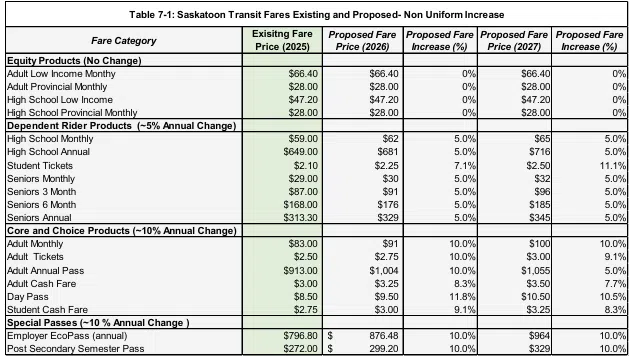
In the transportation file, certain transit fare rates will be increasing in 2026 and 2027. The reform comes as Saskatoon Transit fares have been stagnant since 2016, a quality unique to Saskatoon when compared to other Canadian cities. City Council voted in favour of Administration’s recommendation to increase Dependent Rider, Core/Choice Products, and Special passes by 5, 10, and 10 per cent respectively, while leaving Equity Products alone. Councilor Robert Pearce motioned to keep Dependent rider fares at a zero per cent increase, stating he knows ‘there’s a lot of families who have high school students…and seniors, many of them are on fixed income. I think if we could keep that at zero, (we should) for at least for 2026 and 2027 until the next review process comes up.” However, he was shot down.
On another note, an additional $44,600 will be generated through charging residents and business for false fire alarms. Administration says the false alarm charges would be geared to repeat offenders who fail to expedite repairs. Other approved revisions included cutting City advertising in the Star Phoenix, terminating a subscription to a document management system, reducing property tax reminders to two letters per year, removing weight-based fee exemption for landfill loads under 150 kilograms, and increasing parking ticket fine amounts by $10 in 2026.