





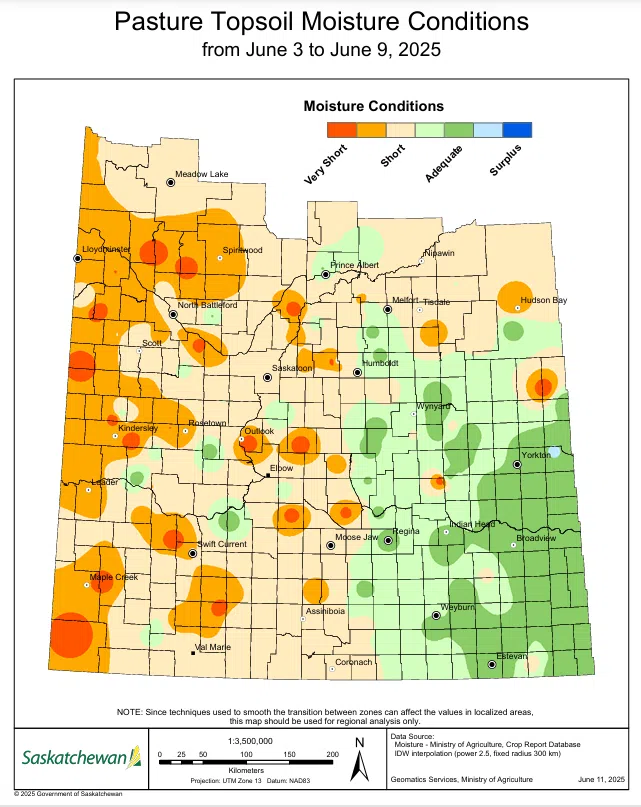
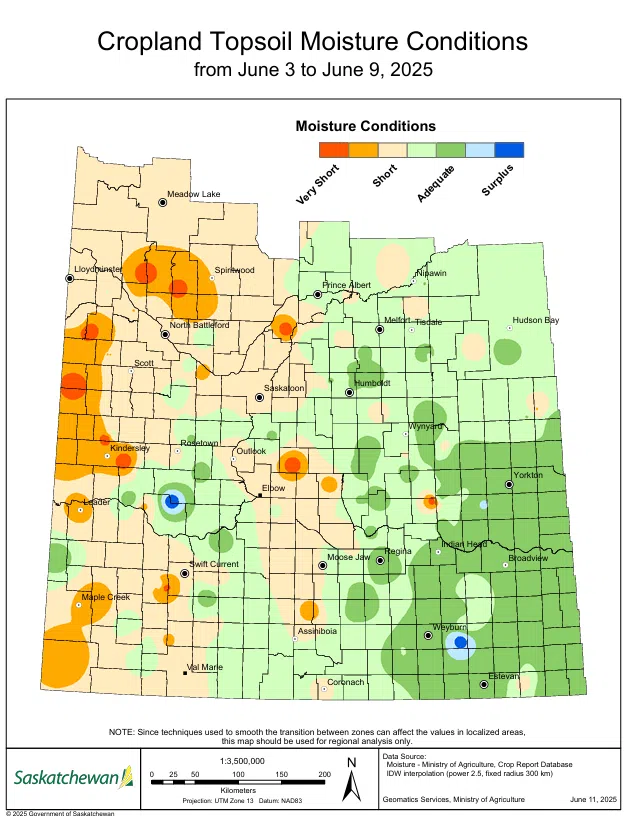
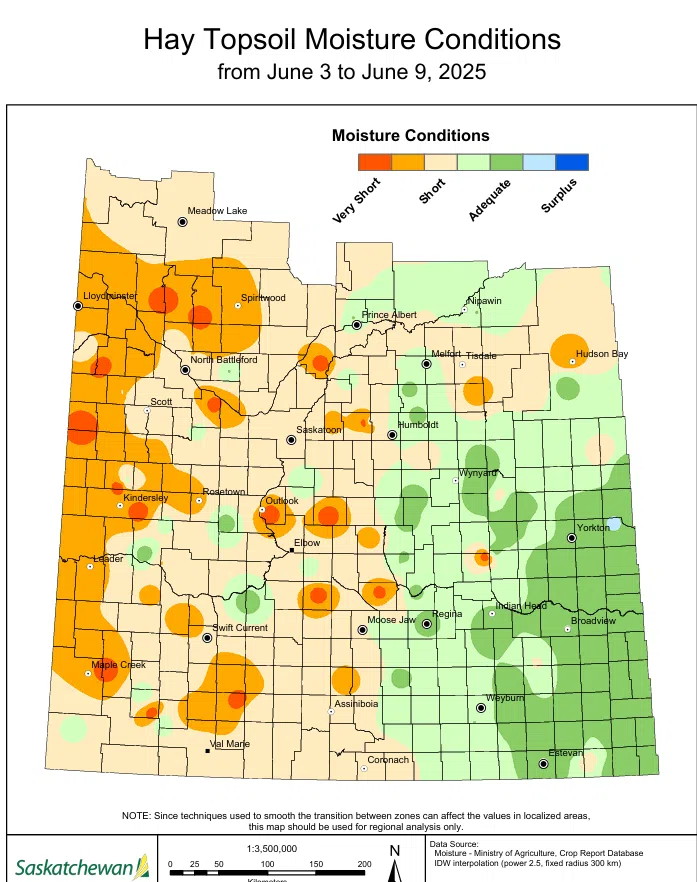
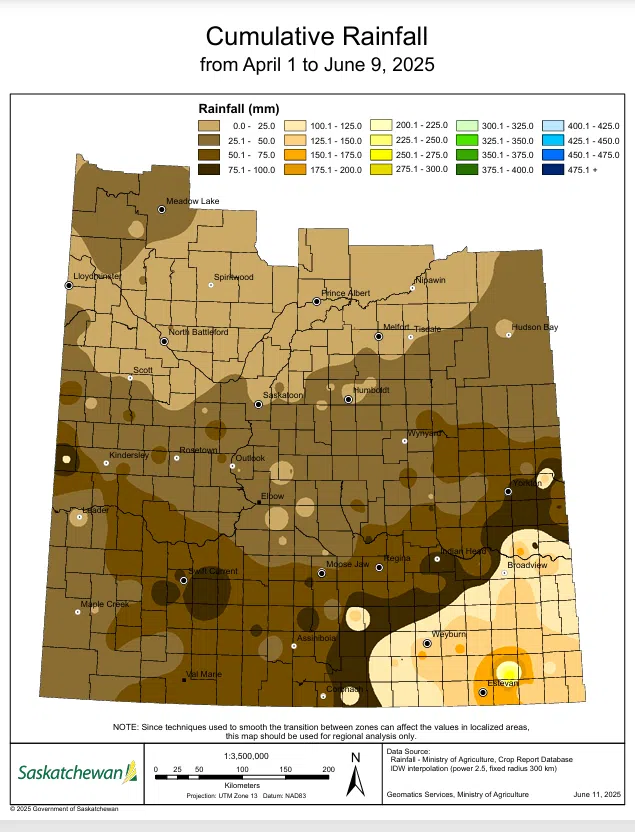
Now that seeding is virtually 100 per cent complete across the province, according to the latest Saskatchewan Agriculture weekly crop report, the focus is now turning to the desperate need for moisture.
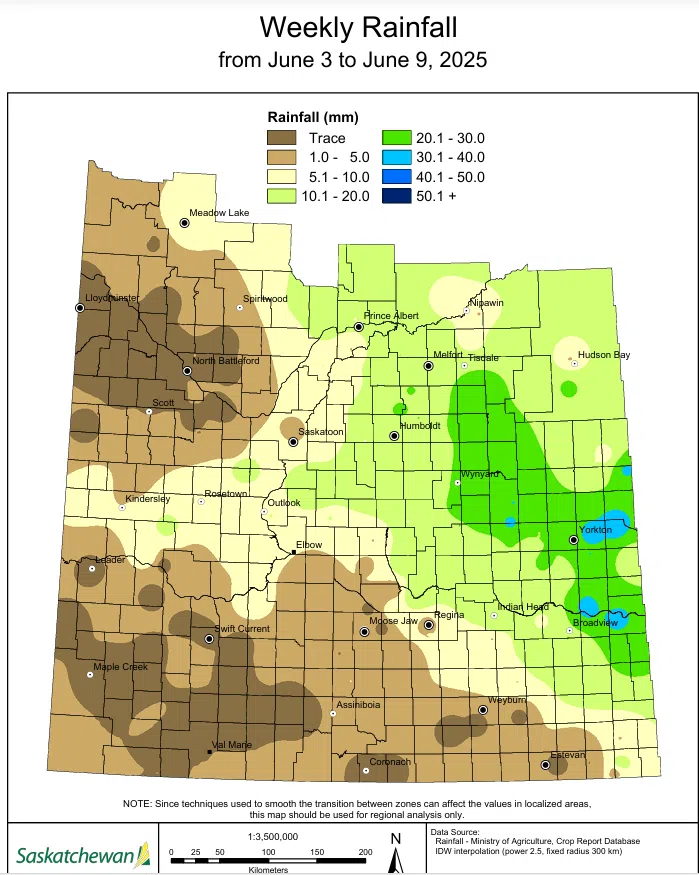
Despite dry and dusty northwest, west central and southwest regions, Crops Extension Specialist Kim Stonehouse says there were several regions that received some welcome rainfall in the week from June 3rd to June 9th.
“Rain fell mostly in the southeast and east central regions…There definitely was some moisture that was received in the northeast, and that was very welcome, as well.”
The Calder area reported the highest amount at 36 millimetres, followed by Stockholm at 35 millimetres and Rocanville at 34 millimetres.
He adds that there have been comments from farmers in drier areas that if they don’t receive moisture soon, there is potential for significant crop damage.
Last week, cropland topsoil moisture was rated as two per cent surplus, 44 per cent adequate, 42 per cent short and 12 per cent very short. Hayland topsoil moisture was reported at 38 per cent adequate, 41 per cent short and 21 per cent very short. Pasture topsoil moisture is 29 per cent adequate, 45 per cent short and 26 per cent very short.
Stonehouse says crop development is in varying stages across the province, with higher moisture content areas seeing a more normal rate of growth.
“In drier areas, we’re seeing crops that when they start to run out of water, one of the things they’ll do is start elongating and putting out seed and/or going to flower. When that’s happening really early, that can be very difficult for yield potential.”
Stonehouse adds that most of the crop damage being seen is driven by wind, heat, and a lack of moisture, but there are other forms of damage as well.
“This week we actually had some frost, and there is wildlife, of course, that’s causing damage to crops. Flea beetles and grasshoppers have been sporadic. There are some areas that are seeing high damage from these insects, but most of the reports say it’s minor damage.”
Next steps for producers include applying in-crop herbicides when the weather is appropriate, which for many, it hasn’t been.
“With the high wind conditions that we’ve had in the last few weeks, that’s making it very difficult to complete that operation. As soon as the wind conditions are favourable, I’m sure they’ll be in the field getting that done as quick as they can.”
The region-by-region crop report is below these images.
Census Division 1 – Carnduff, Estevan, Lampman, Redvers and Stoughton areas
Census Division 2 – Avonlea, Fillmore, Minton, Radville and Weyburn areas
Census Division 5 – Broadview, Esterhazy, Melville and Moosomin areas
Census Division 6 – Belle Plaine, Cupar, Lumsden, Indian Head, Regina and Rouleau areas
For the Period of June 3 to 9, 2025
Most producers have wrapped up seeding within the region apart from a few acres that are being seeded to chickpeas and perennial forage as conditions allow. Overall, producers are reporting good growing conditions with the timely rain that fell this week. Producers will be applying in-crop applications when weather permits and continuing to monitor crops over the coming week.
Rain fell throughout the north half of the region over the past week with a few scattered showers in the south half. The areas to report the highest amounts included the Stockholm area at 35 mm followed by the Rocanville area at 34 mm. The Saltcoats area received 30 mm and the Moosomin area received 25 mm. The Langenburg area reported 24 mm for the past week.
Topsoil moisture continues to be maintained in the region this week. Cropland topsoil moisture is four per cent surplus, 72 per cent adequate, 21 per cent short and three per cent very short. Hayland topsoil moisture is rated as 72 per cent adequate, 23 per cent short and five per cent very short. Pasture topsoil moisture is one per cent surplus, 70 per cent adequate, 25 per cent short and four per cent very short.
Varying stages of development are reported within the region given the varied amounts of rain that producers have received.
- Thirty-one per cent of winter cereals are in the tillering stage, 18 per cent at stem elongation, 37 per cent at flag leaf and 14 per cent heading.
- Thirteen per cent of spring cereals are at the pre-emergent stage with 48 per cent at the seedling stage, 32 per cent tillering and seven per cent starting stem elongation.
- Seven per cent of pulse crops are at the pre-emergent stage with 59 per cent at the seedling stage and 34 per cent reported at the vegetative stage of development.
- Twenty-two per cent of canola and mustard are at the pre-emergent stage, 65 per cent are at the seedling stage and 13 per cent at the rosette stage.
- Twenty-one per cent of the flax is at the pre-emergent stage, 73 per cent at the seedling stage and six per cent of these crops are beginning the stem elongation stage.
Minor to moderate crop damage was reported in the region due to wind, dry conditions and heat with some areas indicating more severe damage. Minor crop damage due to frost and flooding were also reported within the region over the past week. Producers will continue to monitor flea beetles and wildlife damage as the season continues but some minor to moderate crop damage has been reported in some areas.
Census Division 3 – Assiniboia, Gravelbourg, Mankota, Ponteix and Rockglen areas
Census Division 4 – Cadillac, Consul, Eastend, Maple Creek and Val Marie areas
Census Division 7 – Beechy, Central Butte, Craik, Herbert, Hodgeville and Moose Jaw areas
Census Division 8 – Cabri, Elrose, Fox Valley, Leader, Swift Current and Tompkins areas
For the Period June 3 to 9, 2025
As seeding wraps up in the region, producers are busy continuing to monitor their crops and are beginning spray operations as weather permits. Producers report that pasture and hayland are suffering due to dry conditions within the region.
Rain was limited throughout the region this week with the highest amount recorded in the Eston area at 13 mm. The Fillmore and Mossbank areas received only five mm while the rest of the region was less.
The lack of rainfall continued to reduce soil moisture within the region. Cropland topsoil moisture is three per cent surplus, 29 per cent adequate, 54 per cent short and 14 per cent very short. Hayland topsoil moisture is rated as 19 per cent adequate, 49 per cent short and 32 per cent very short. Pasture topsoil moisture is 16 per cent adequate, 52 per cent short and 32 per cent very short.
Producers report a large variation in crop development given the dry and windy conditions throughout the region.
- Seven per cent of winter cereals are in the stem elongation stage, 23 per cent at flag leaf, 57 per cent are heading and 13 per cent are in the dough stage.
- Seven per cent of spring cereals are at the pre-emergent stage with 40 per cent at the seedling stage, 43 per cent are tillering, nine percent is in the stem elongation stage and one percent at flag leaf.
- Ten per cent of pulse crops are at the pre-emergent stage with 47 per cent at the seedling stage and 43 per cent at the vegetative stage of development.
- Thirteen per cent of canola and mustard are at the pre-emergent stage, 52 per cent are at the seedling stage and 33 per cent at the rosette stage while, one per cent is bolting and one per cent is flowering.
- Six per cent of the flax is at the pre-emergent stage, 70 per cent at the seedling stage and 24 per cent of these crops are starting stem elongation.
Dry conditions, wind and heat caused minor to moderate crop damage over the past week with some indications of more severe damage. Minor to moderate crop damage was reported due to wildlife with some producers reporting minor damage due to flea beetles, grasshoppers, wireworms and frost. Producers will continue to monitor their fields and apply in-crop weed control applications as weather permits.
Census Division 9 – Calder, Canora, Pelly, Preeceville, Sheho and Yorkton areas
Census Division 10 – Foam Lake, Kelliher, Leroy, Raymore and Wadena areas
Census Division 11 – Davidson, Colonsay, Langham, Lanigan, Nokomis, Outlook and Saskatoon areas
For the Period June 3 to 9, 2025
Seeding was able to advance within the region despite earlier rain delays. The east-central region overall is reporting 99 per cent seeding completion although, some lower acreage crops have yet to be seeded.
Rain was widespread throughout the region the past week with a few areas reporting increased amounts. The Calder area reported the highest amount at 36 mm. The Yorkton area reported 33 mm, the Foam Lake area recorded 32 mm and the Pelly area reported 31 mm.
Topsoil moisture improved in the region this week. Cropland topsoil moisture is one per cent surplus, 53 per cent adequate, 35 per cent short and 11 per cent very short. Hayland topsoil moisture is rated as two per cent surplus, 47 per cent adequate, 32 per cent short and 19 per cent very short. Pasture topsoil moisture is two per cent surplus, 44 per cent adequate, 29 per cent short and 25 per cent very short.
Crop development is slower within the region relative to other areas of the province.
- Twenty-five per cent of winter cereals are in the tillering stage, 33 per cent at stem elongation, 23 per cent at flag leaf and 19 per cent is at the heading stage.
- Eleven per cent of spring cereals are at the pre-emergent stage, 45 per cent at the seedling stage, 35 per cent at the tillering stage with nine per cent starting stem elongation.
- Two per cent of pulse crops are at the pre-emergent stage with 30 per cent at the seedling stage, 67 per cent at the vegetative stage and one percent flowering.
- Twenty-five per cent of canola and mustard are at the pre-emergent stage, 63 per cent are at the seedling stage and 12 per cent at the rosette stage.
- Twenty-seven per cent of the flax is at the pre-emergent stage with 53 per cent at the seedling stage and 20 per cent beginning stem elongation.
Minor to moderate crop damage was reported in the region due to wind, dry conditions and heat. Elevated damage was also reported due to wind. Other environmental factors that were reported to have caused minor damage this week are frost, flooding, hail and wildlife. Minor to moderate crop damage was reported due to flea beetles with some producers beginning to take control measures. Producers also noted that a number of crop diseases were beginning to cause minor crop damage.
Census Division 12 – Biggar, Delisle, Rosetown and Sonningdale areas
Census Division 13 – Cut Knife, Kerrobert, Kindersley, Macklin, Plenty and Wilkie areas
For the Period June 3 to 9, 2025
Most producers have wrapped up seeding within the region. Overall, producers are reporting growing conditions have deteriorated due to dry conditions. Pastures and hay have slowed in development, and producers are not optimistic about their potential if rain does not happen soon. Producers will be applying in-crop applications when weather permits and continuing to monitor crops over the coming week.
Rainfall was limited throughout the region with the east side of the region receiving slightly higher amounts of rain over the past week. The highest rainfall recorded was in the Harris area at 14 mm followed by the Rosetown and Major areas that each received nine mm.
Topsoil moisture decreased significantly in the region this week. Cropland topsoil moisture is 18 per cent adequate, 53 per cent short and 29 per cent very short. Hayland topsoil moisture is rated as 11 per cent adequate, 51 per cent short and 38 per cent very short. Pasture topsoil moisture is 11 per cent adequate, 49 per cent short and 40 per cent very short.
Crop development is advancing quicker than expected for some crops due to the dry, windy conditions.
- Sixty-eight per cent of winter cereals are in the flag leaf stage and 32 per cent are heading.
- Seven per cent of spring cereals are at the pre-emergent stage, 44 per cent at the seedling stage, 44 per cent are at tillering, four per cent are at stem elongation and one per cent is at the flag leaf stage.
- Five per cent of pulse crops are at the pre-emergent stage with 49 per cent at the seedling stage and 46 per cent at the vegetative stage of development.
- Fourteen per cent of canola and mustard are at the pre-emergent stage, 74 per cent are at the seedling stage and 12 per cent at the rosette stage.
- Eight per cent of the flax is at the pre-emergent stage with 79 per cent at the seedling stage and 13 per cent starting stem elongation.
Producers reported moderate to severe crop damage due to dry conditions, wind and heat within the region. Crop damage due to frost was also reported. Producers will continue to monitor flea beetle and grasshopper pressure; at this point most crop damage has been minor but some control measures are being taken.
Census Division 14 – Choiceland, Hudson Bay, Kelvington, Melfort, and Nipawin areas
Census Division 15 – Cudworth, Humboldt, Kinistino, Prince Albert, Rosthern and St. Brieux areas
For the Period June 3 to 9, 2025
Due to limited interruptions, seeding was able to advance within the region over the past week. Overall, the northeast region is reporting 100 per cent seeding completion. Although, some seeding of lower acreage crops still remains to be completed. Producers noted that crops with spotty emergence were beginning to fill in with the recent precipitation that was received.
Rain fell throughout most of the region this week. The highest amount recorded was in the Archerwill area at 30 mm. This was followed by the Kelvington area at 24 mm and the Rose Valley and Middle Lake areas that both received 22 mm. Hudson Bay recorded 21 mm while Nipawin, Lake Lenore and Kinistino each received 20 mm.
Topsoil moisture improved slightly with some areas reporting more adequate moisture conditions. Cropland topsoil moisture is 43 per cent adequate, 50 per cent short and seven per cent very short. Hayland topsoil moisture is rated as 25 per cent adequate, 58 per cent short and 17 per cent very short. Pasture topsoil moisture is 24 per cent adequate, 54 per cent short and 22 per cent very short.
Recent wet weather has allowed improved crop development within the region for crops that were slow to emerge.
- Five per cent of winter cereals are in the tillering stage, 36 per cent at stem elongation, nine per cent at flag leaf and 50 per cent at heading.
- Six per cent of spring cereals are at the pre-emergent stage, 54 per cent at the seedling stage, 36 per cent are tillering and four per cent are at the stem elongation stage.
- Forty-one per cent of pulse crops are at the seedling stage with 59 per cent at the vegetative stage of development.
- Seventeen per cent of canola and mustard are at the pre-emergent stage, 74 per cent are at the seedling stage and nine per cent at the rosette stage.
- Five per cent of the flax is at the pre-emergent stage with 85 per cent at the seedling stage and 10 per cent at stem elongation.
Minor to moderate crop damage was reported in the region due to heat over the past week. Increased levels of damage were reported due to dry and windy conditions. Some crop damage due to hail and frost was also reported. Minor to moderate crop damage occurred due to flea beetles with some reports of more severe damage. Minor grasshopper, cutworm and pea leaf weevil was noted within the region as well.
Census Division 16 – Blaine Lake, Canwood, North Battleford, Radisson and Spiritwood areas
Census Division 17 – Glaslyn, Maidstone, Meadow Lake, Pierceland and St. Walburg areas
For the Period June 3 to 9, 2025
Most producers have wrapped up seeding within the region. Overall, producers are reporting growing conditions have deteriorated due to dry conditions. Pastures and hay have slowed in development, and producers are not optimistic about their potential if rain does not happen soon. Producers will be applying in-crop applications when weather permits and continuing to monitor crops over the coming week.
Limited rain fell throughout the region over the past week. The highest amount recorded was in the Shellbrook area at 16 mm followed by the Canwood area at 11 mm. The Meadow Lake area received 10 mm.
Topsoil moisture continues to decline within the region this week. Cropland topsoil moisture is 14 per cent adequate, 65 per cent short and 21 per cent very short. Hayland topsoil moisture is rated as eight per cent adequate, 60 per cent short and 32 per cent very short. Pasture topsoil moisture is seven per cent adequate, 57 per cent short and 36 per cent very short.
Producers report a slow progression in crop development given the dry and windy conditions throughout the region.
- Eighty-two per cent of winter cereals are in the tillering stage, five per cent at stem elongation, one per cent at flag leaf and 12 per cent at heading.
- Four per cent of spring cereals are at the pre-emergent stage, 51 per cent at the seedling stage, 44 per cent are tillering and one per cent is at the heading stage.
- Nine per cent of pulse crops are at the pre-emergent stage with 27 per cent at the seedling stage and 64 per cent at the vegetative stage of development.
- Eleven per cent of canola and mustard are at the pre-emergent stage, 72 per cent are at the seedling stage and 17 per cent at the rosette stage.
- Seventy-five per cent of the flax is at the seedling stage with 25 per cent at the stem elongation stage.
Minor to moderate crop damage was reported in the region due to wind, heat and dry conditions over the past week. Minor damage due to frost was also noted. Minor to moderate crop damage occurred due to flea beetles with some producers taking control measures. There were also some reports of minor damage due to grasshoppers and pea leaf weevil.