




The Mass Casualty Commission report released today describes the gunman as violent and coercive in his intimate partner relationships, and this violence against his spouse was directly connected to his perpetration of the mass casualties on April 18 and 19, 2020 in Nova Scotia.
Twenty-two people were killed including one expecting a child in the worst mass shooting in Canadian history.
The commission draws a line between mass violence and its relationship to other more pervasive forms of violence with the everydayness and seeming normalcy of violence between intimate partners and within families and the ways in which this violence spills out to affect other people too.
The inquiry heard the 51-year-old disguised himself as a police officer and drove a replica police cruiser during a 13-hour rampage that ended when he was shot dead by two RCMP officers at a gas station north of Halifax.
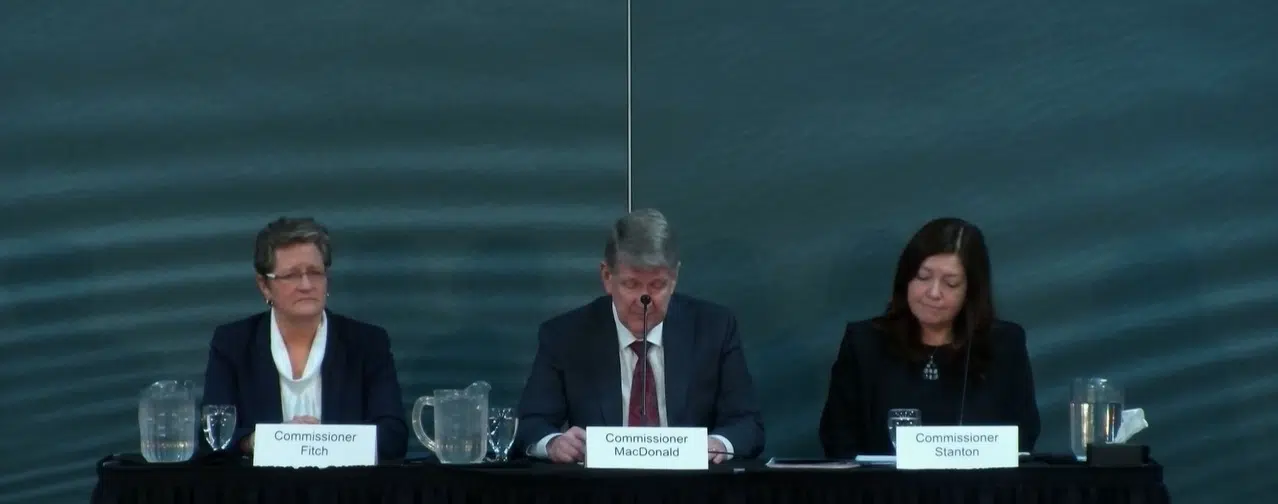
Commissioners Michael MacDonald, Leanne Fitch, and Kim Stanton spoke at the event in Truro, Nova Scotia today where they released the seven-volume report which contains 130 recommendations.
The commission calls for an overhaul of the national police force including moving away from the depot model of training. RCMP Depot is located in Regina.
The commission recommends the Criminal Code be changed to prohibit all semi-automatic handguns, semi-automatic rifles, and shotguns that discharge centre-fire ammunition or can accept detachable magazines with capacities of more than five rounds; and ban the use of a magazine with more than five rounds.
The report suggests the responsibility for alerting the public needs to change. Right now, it is supplied by a private provider, Pelmorex, which owns the Alert Ready software system. The federal government engages Pelmorex to deliver the service. It is the same system which interrupts broadcast programming in Saskatchewan with an automated message for things like Amber Alerts and tornado warnings.