



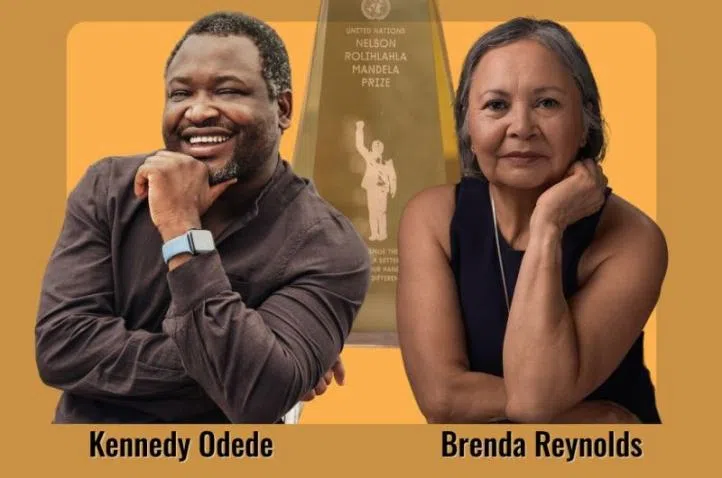
Brenda Reynolds, an Indigenous social worker and a status treaty member of the Fishing Lake Saulteaux First Nation, was one of two recipients receiving the honour.
The UN Nelson Rolihlahla Mandela Prize is awarded to two people every five years. (Social entrepeneur Kennedy Odede of Kenya was the other recipient)
Reynolds is a social worker and nationally recognized leader in Indigenous health, trauma-informed care, and reconciliation. She also played a vital role in the largest court-ordered Indian Residential School Settlement Agreement. The provincial NDP caucus held a reception for Reynolds at the Legislature on Thursday.
“To recognize a trailblazer such as Brenda is a privilege,” said Betty Nippi-Albright, the Shadow Minister for Mental Health and Addictions. “The work she has done and continues to do is a beacon of hope for Indigenous people not just in Canada but all over the world”
Reynolds career summary from the UN news release is below:
Brenda Reynolds
Brenda Reynolds, a Status Treaty member of the Fishing Lake Saulteaux First Nation, Saskatchewan, brings a lifetime of lived experience, advocacy and professional leadership to the forefront of Indigenous health, mental wellness and reconciliation efforts in Canada and internationally. Her personal journey — from impacts of cultural genocide to a nationally recognized leader in trauma-informed care — has shaped her deep commitment to addressing the intergenerational impacts of the Indian Residential School system and government assimilation policies.
A social worker, Brenda has varied work experiences with First Nation community work, provincial and federal governments. She played a pivotal role in the largest to date court-ordered Indian Residential Schools Settlement Agreement. Her leadership helped establish the Indian Residential School Resolution Health Support Program — a national, culturally grounded mental health initiative. The Resolution Health Support workers became the first trauma responders to the Indian residential school survivors, their families and Canadians. This programme is still funded and active today, noted for its contributions to healing and post-traumatic growth.
In 1988, Brenda worked and supported 17 teen girls who disclosed sexual abuse at Gordon’s Residential School by a staff member. This was the first court case of sexual abuse by an Indian residential school staff member in Saskatchewan. The final report of the Truth and Reconciliation Commission later stated that the Gordon’s Indian Residential School has become known as one of the “worst run schools in the entire residential school system”.
Brenda later worked as a special adviser to the Truth and Reconciliation Commission, where she coordinated survivor support at national events and advised Commissioners on trauma response. Her ability to mediate, de-escalate and lead with compassion earned the praise of law enforcement and event organizers alike.
Brenda’s expertise is sought globally. In 2023, she was invited by the United Nations High Commissioner for Human Rights and the European Union to share her insights on trauma and cultural genocide. Her doctoral studies in clinical psychology focus on trauma interventions for cultural genocide, further contributing to global academic understanding.
Brenda continues to provide consultation and training across Canada and internationally, bringing clarity and compassion to complex conversations on trauma, reconciliation and healing. She currently resides in Alberta, Canada.