




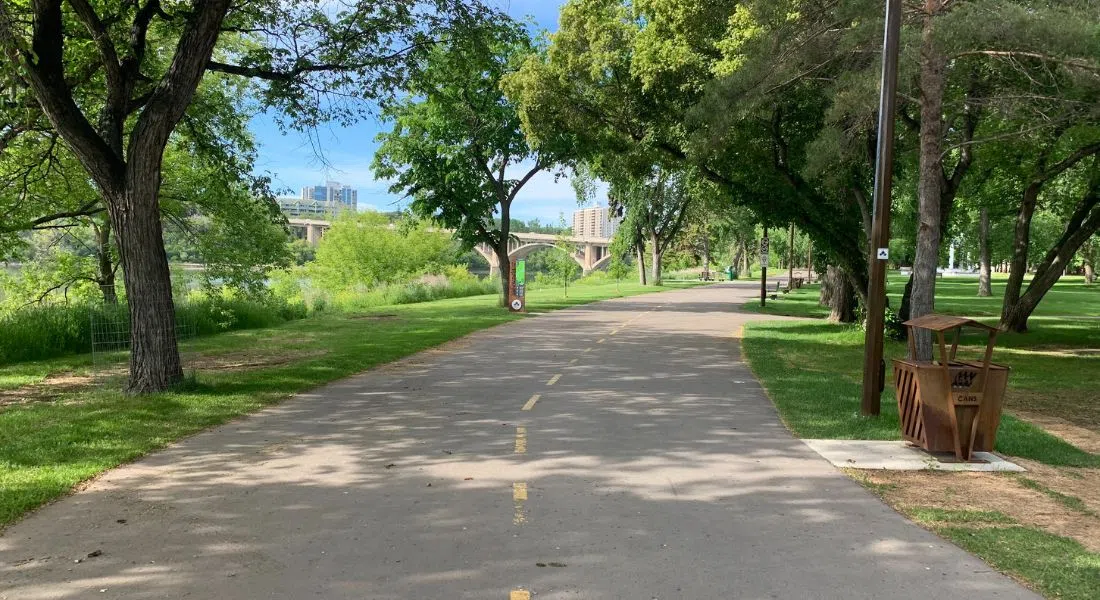
The Canadian Inclusive Green Spaces Symposium was hosted by Canadian Parks & Recreation Association (CPRA) and Saskatchewan Parks and Recreation Association (SPRA) in Saskatoon last week, next to Meewasin, which is a candidate for being Canada’s next national urban park site.
The purpose of the symposium is to enhance access to nature through the lens of equity, diversity, inclusion, and reconciliation. There are many barriers as to why people may not have access to parks, and the symposium is a means to have conversations to foster physical and mental health through improving access to greenspace and bringing forward information to policy makers.
Martin Sampson is the CEO with Canadian Parks and Recreation Association and said some of the barriers that are part of the ongoing discussion are how in some communities there are no parks within walking distance from where people live, physical or mobility issues, some parks are not particularly well-designed for women and girls, and members of minority communities tend to disproportionately live in socially economically challenged neighbourhoods, which don’t have the same amenities as other neighbourhoods.
Sampson says, “We know in an environment with tree canopy, which is usually in parks, the ambient temperature can be 10…12…15 degrees cooler. If you’re a pensioner living on a fixed income without air conditioning, the difference of 15 degrees can be the difference between life and death. We are not suggesting that this solves all of that, but it is a really important component of climate resistance.”
Sampson emphasizes how important it is having access to the natural world with trees in your neighbourhood, the ability to participate in outdoor recreational activities of your choice-in that environment-is profoundly good for you and the community in which you live.