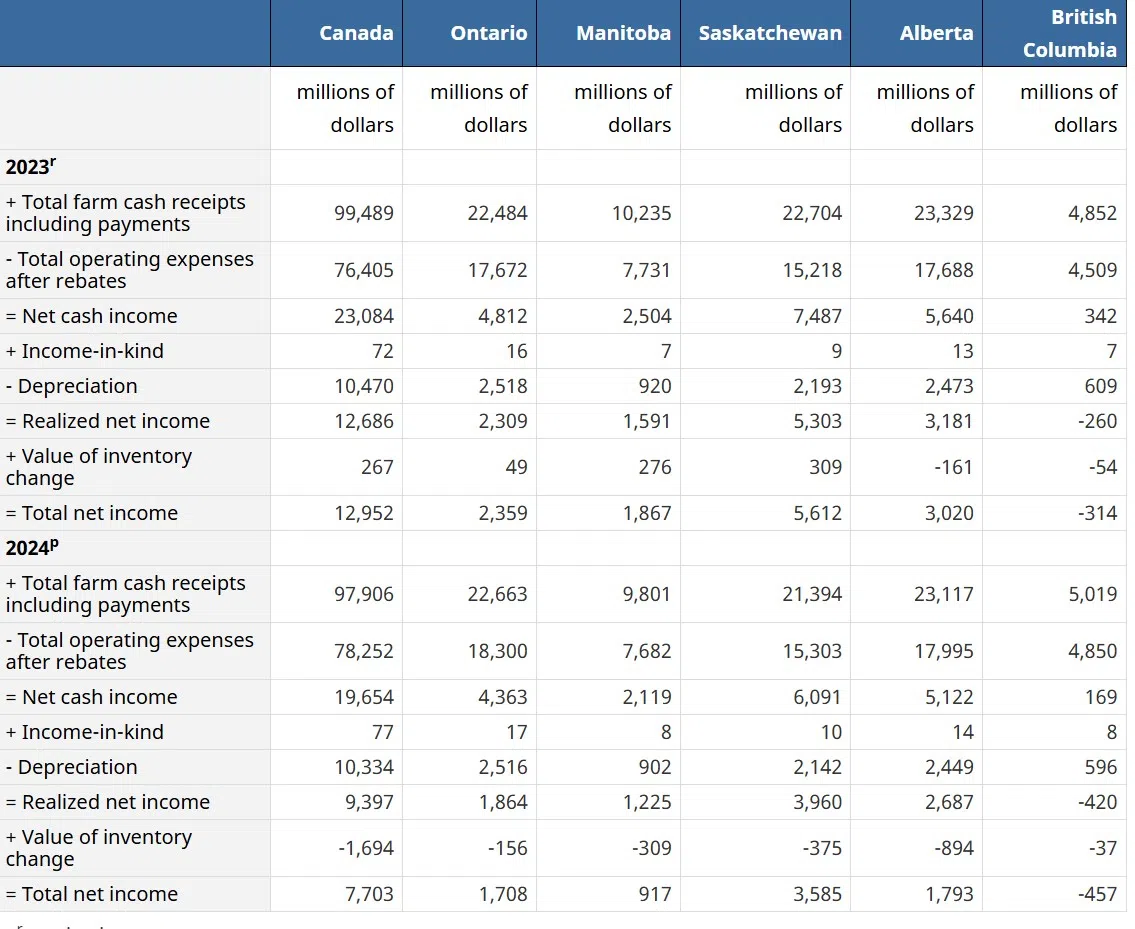




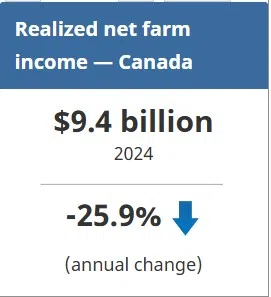
Statistics Canada is reporting realized net farm income fell 25.9 per cent last year—the largest percentage decline since 2018. When cannabis is not included, the drop is 23 per cent.
Realized net income is the difference between a farmer’s cash receipts and operating expenses, minus depreciation, plus income in-kind.
Lower farm cash receipts and slightly higher operating expenses led to the decrease. An increase in livestock revenue was more than offset by declines in crop returns. Lower crop insurance payments also reduced income.
StatsCan says total crop receipts fell 6.2 per cent to $52.1 billion last year. This was the largest percentage decline in crop receipts since 2003. Saskatchewan saw the largest decline in crop receipts at $1.7 billion followed by Alberta at $1.1 billion and Manitoba $662.9 million. Ample domestic and international supplies put downward pressure on prices. There were lower crop receipts, despite an increase in the amount of grains and oilseed sold by producers.
Crop Insurance payments were 10.2 percent lower last year.
The one bright spot last year was livestock receipts, which rose 6.9 percent on a national basis. The total was just a shade under $40 billion. Cattle and calves accounted for two-thirds of the increase, powered by record market prices and strong beef demand.
Total operating expenses increased a modest 2.4 percent to $78.3 billion. Farm debt rose 14.1 percent last year—the largest annual increase since 1981.
Breaking it down by province, Saskatchewan’s total net farm income dropped from $5.6 billion in 2023 to $3.6 billion last year.
However, Saskatchewan still had the highest total farm income by a wide margin. Second place went to Alberta at $1.8 billion, followed by Ontario at $1.7 billion and then Manitoba at $921 million. Last among the provinces is British Columbia which had a total farm income loss totaling $346 million.