




Limited rainfall has pushed seeding well ahead of the five-year average—but many areas of the province could use moisture for emerging crops.
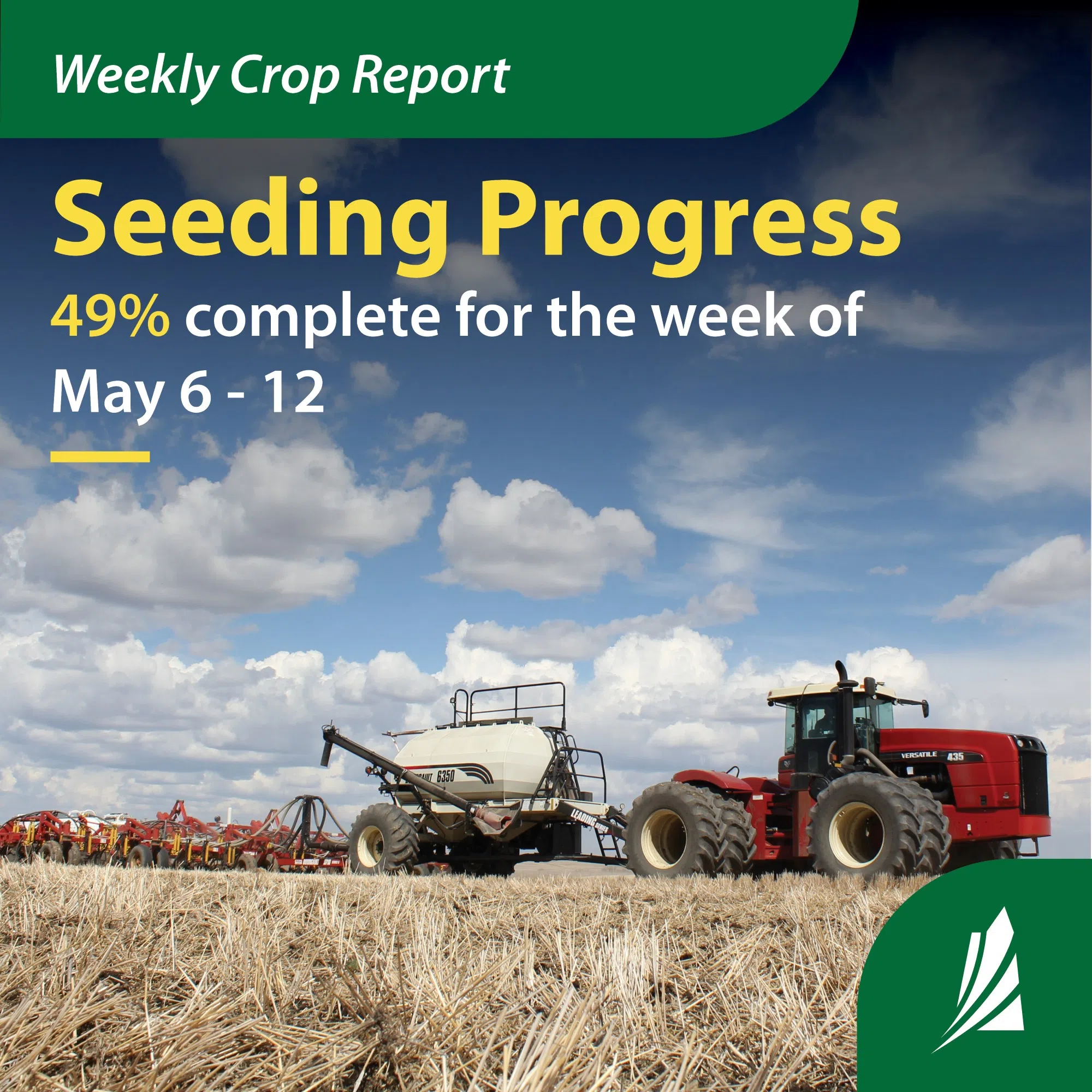
The Saskatchewan Ministry of Agriculture weekly crop report says 49 per cent of intended acres had been seeded as of Monday. The five-year average is 32 per cent and the 10-year is 34 per cent.
Seeding progress is most advanced in the southwest at 76 per cent followed by the northwest at 49 per cent. The southeast, west-central and northeast regions are all at 43 per cent with the east-central at 33 per cent.
This is the provincial seeding progress by crop:
Peas 78 per cent
Lentils 71 per cent
Durum 65 per cent
Chickpeas 65 per cent
Spring Wheat 53 per cent
Barley 45 per cent
Canola 29 per cent
Flax 28 per cent
Oats 28 per cent
Warm, dry and windy conditions continue to deplete topsoil moisture across the province. Rain over the eastern third of the province Thursday and Friday will help those regions. Prior to the rain, provincial cropland topsoil moisture was one per cent surplus, 61 per cent adequate, 35 per cent short and three per cent very short. Pasture topsoil moisture conditions are 42 per cent adequate, 50 per cent short and eight per cent very short.
Fifty-four per cent of livestock producers estimate there will be no shortages of on-farm surface water supplies. Thirty-two per cent indicate shortages may occur in one or two months depending on future moisture conditions. Twelve per cent says there are currently moderate on-farm surface shortages.
You can check out the region-by-region crop report below:
SOUTHEAST
Census Division 1-Carnduff, Estevan, Lampman, Redvers and Stoughton
Census Division 2-Avonlea, Fillmore, Minton, Radville and Weyburn Broadview, Esterhazy, Melville and Moosomin areas
Cenus Division 3- Belle Plaine, Cupar, Lumsden, Indian Head, Regina and Rouleau areas
Producers were able to make considerable seeding progress over the past week. Currently, seeding is 43 per cent complete within the region. This is up 29 per cent from last week and ahead of the five-year regional average of 27 per cent
Pulse crops lead in seeding completion with field peas at 76 per cent complete, chickpeas at 61 per cent and lentils at 58 per cent complete within the region. Durum is the highest in seeding completion of the cereals at 53 per cent, followed by spring wheat at 42 per cent, oats at 40 per cent, barley at 39 per cent, triticale at 21 per cent and canary seed at 18 per cent. Of the oilseed crops, mustard is the furthest ahead in seeding completion at 24 per cent, followed by flax at 22 per cent and canola at 20 per cent. The furthest behind in seeding completion for the region is soybeans at 14 per cent followed by perennial forage at 10 per cent complete.
| Southeastern Saskatchewan | |
| Census division | % seeded (May 12, 2025) |
| 1 | 51% |
| 2 | 60% |
| 5 | 26% |
| 6 | 36% |
| Region average | 43% |
Although precipitation fell within parts of the region over the past week, amounts were limited overall. The highest rainfall recorded fell in the Lipton and Lumsden areas at 8 millimetres (mm) and 5 mm, respectively. The Regina, Glenavon and Radville areas all reported 3 mm over the past week.
Currently, cropland topsoil moisture within the region is rated as two per cent surplus, 73 per cent adequate, 24 per cent short and one per cent very short. Hay land topsoil moisture is rated as 61 per cent adequate, 34 per cent short and five per cent very short. Pasture is rated at 57 per cent adequate, 36 per cent short and seven per cent very short.
Within the region, currently 57 cent of producers estimate there are no shortages of on-farm surface water supplies for livestock occurring or anticipated, with 31 per cent estimating that shortages may occur in one to two months depending on future moisture conditions. Ten per cent of producers are currently indicating that moderate shortages are occurring with two per cent reporting severe shortages occurring. Currently, 86 per cent of producers are not concerned with water quality for their livestock at this time.
Producers are busy with seeding, pre-seed herbicide spraying for weeds, land rolling and rock picking. Calving is wrapping up with livestock producers busy checking fences and starting to move cattle out to pasture.
SOUTHWEST
Census Division 3 – Assiniboia, Gravelbourg, Mankota, Ponteix and Rockglen areas
Census Division 4 – Cadillac, Consul, Eastend, Maple Creek and Val Marie areas
Census Division 7 – Beechy, Central Butte, Craik, Herbert, Hodgeville and Moose Jaw areas
Census Division 8 – Cabri, Elrose, Fox Valley, Leader, Swift Current and Tompkins areas
For the Period May 6 to 12, 2025
Producers were able to make rapid seeding progress over the past week with some producers wrapping up seeding for the year. Currently, seeding is 76 per cent complete within the region. This is up 33 per cent from last week and ahead of the five-year regional average of 49 per cent.
| Southwestern Saskatchewan | |
| Census Division | % seeded (May 12, 2025) |
| 3 | 73% |
| 4 | 86% |
| 7 | 68% |
| 8 | 80% |
| Region average | 76% |
All crops within the region made considerable seeding progress over the past week. Of the pulse crops, field peas are the furthest ahead in seeding completion at 91 per cent, followed by lentils at 81 per cent and chickpeas at 78 per cent. Triticale is the furthest ahead in seeding completion for the cereal crops in the region at 96 per cent, followed by barley at 83 per cent, durum at 80 per cent, spring wheat at 75 per cent, oats at 64 per cent and canary seed at 61 per cent. Of the oilseed crops, mustard leads in seeding completion at 87 per cent, followed by canola at 80 per cent and flax at 67 per cent. Soybeans are currently 73 per cent seeded within the region and perennial forage is 57 per cent seeded.
Trace amounts of precipitation were recorded over much of the region over the past week. The highest rainfall recorded fell in the Tuxford area at 5 millimetres (mm), followed by the Moose Jaw and Shaunavon areas at 3 mm.
Currently, cropland topsoil moisture is rated as 48 per cent adequate, 47 per cent short and five per cent very short. Hay land topsoil moisture is rated as 32 per cent adequate, 62 per cent short and six per cent very short. Pasture is rated at 29 per cent adequate, 62 per cent short and nine per cent very short.
Within the region, currently 38 cent of producers estimate there are no shortages of on-farm surface water supplies for livestock occurring or anticipated, with 41 per cent estimating that shortages may occur in one to two months depending on future moisture conditions. Seventeen per cent of producers are currently indicating that moderate shortages are occurring with four per cent reporting severe shortages occurring. Currently, 76 per cent of producers are not concerned with water quality for their livestock at this time.
Producers are continuing with seeding, herbicide spraying for weeds, land rolling and rock picking. Livestock producers are busy checking fences, moving cattle out to pasture, and brandings have started within the region.
WEST CENTRAL
Census Division 12 – Biggar, Delisle, Rosetown and Sonningdale areas
Census Division 13 – Cut Knife, Kerrobert, Kindersley, Macklin, Plenty and Wilkie areas
Producers were able to make substantial seeding progress over the past week despite some areas within the region receiving rainfall. Currently, seeding is 43 per cent complete within the region. This is up 32 per cent from last week and ahead of the five-year regional average of 36 per cent.
| West-Central Saskatchewan | |
| Census Division |
% seeded (May 12, 2025) |
| 12 | 40% |
| 13 | 44% |
| Region average | 43% |
Pulse crops lead in seeding completion with lentils at 72 per cent complete and field peas at 68 per cent complete within the region. Spring wheat is the highest in seeding completion of the cereals at 49 per cent, followed by durum at 36 per cent, barley at 34 per cent, canary seed at 30 per cent and oats at two per cent. Of the oilseed crops, canola is the furthest ahead in seeding completion at 37 per cent, followed by flax at 24 per cent and mustard at 21 per cent. Perennial forage and soybeans are the furthest behind in seeding completion at nine per cent and one per cent, respectively.
Although precipitation fell within parts of the region over the past week, many areas received trace amounts. The highest rainfall recorded fell in the Marengo area at 14 millimetres (mm). The Macklin area reported 10 mm followed by the Marsden area at 8 mm.
Currently, cropland topsoil moisture is rated as one per cent surplus, 59 per cent adequate, 34 per cent short and six per cent very short. Hay land topsoil moisture is rated as one per cent surplus, 48 per cent adequate, 41 per cent short and 10 per cent very short. Pasture is rated at one per cent surplus, 47 per cent adequate, 43 per cent short and nine per cent very short.
Within the region, currently 56 cent of producers estimate there are no shortages of on-farm surface water supplies for livestock occurring or anticipated, with 35 per cent estimating that shortages may occur in one to two months depending on future moisture conditions and nine per cent of producers are indicating that moderate shortages are occurring. Currently, 87 per cent of producers are not concerned with water quality for their livestock at this time.
Producers are continuing with seeding, herbicide spraying for weeds, land rolling and rock picking. Livestock producers are busy finishing calving, checking fences and starting to move cattle out to pasture in some areas.
For more information about West-Central Saskatchewan, explore the Crop Report Dashboard.
EAST CENTRAL
Census Division 9 – Calder, Canora, Pelly, Preeceville, Sheho and Yorkton areas
Census Division 10 – Foam Lake, Kelliher, Leroy, Raymore and Wadena areas
Census Division 11 – Davidson, Colonsay, Langham, Lanigan, Nokomis, Outlook and Saskatoon areas
Although there was scattered rainfall within the region, producers were able to make considerable seeding progress over the past week. Currently, seeding is 33 per cent complete within the region. This is up 24 per cent from last week and ahead of the five-year regional average of 17 per cent.
| East-Central Saskatchewan | |
| Census Division | % seeded (May 5, 2025) |
| 9 | 25% |
| 10 | 20% |
| 11 | 48% |
| Region average | 33% |
Of the crops seeded within the region, durum is the farthest along at 82 per cent seeded, followed by lentils at 66 per cent and field peas at 64 per cent. Spring wheat is currently 37 per cent seeded, followed by barley at 32 per cent, flax at 23 per cent, canola at 18 per cent and oats at 13 per cent. Perennial forage and soybeans are the furthest behind in seeding completion at 11 per cent and two per cent, respectively.
Precipitation was scattered throughout the region over the past week. The highest rainfall recorded fell in the Wadena area at 13 millimetres (mm) followed by the Canora area that recorded 8 mm.
Currently, cropland topsoil moisture is rated as one per cent surplus, 65 per cent adequate, 33 per cent short and one per cent very short. Hay land topsoil moisture is rated as two per cent surplus, 61 per cent adequate, 28 per cent short and nine per cent very short. Pasture is rated at one per cent surplus, 53 per cent adequate, 36 per cent short and 10 per cent very short.
Within the region, currently 72 cent of producers estimate there are no shortages of on-farm surface water supplies for livestock occurring or anticipated, with 24 per cent estimating that shortages may occur in one to two months depending on future moisture conditions and four per cent of producers are indicating that moderate shortages are occurring. Currently 90 per cent of producers are not concerned with water quality for their livestock at this time.
Producers are busy with seeding, pre-seed herbicide spraying for weeds, harrowing, land rolling and rock picking. Some livestock producers are starting to move cattle out to pasture, while others are continuing to feed their cattle to allow pastures a chance to grow.
NORTHEAST
Census Division 14 – Choiceland, Hudson Bay, Kelvington, Melfort, and Nipawin areas
Census Division 15 – Cudworth, Humboldt, Kinistino, Prince Albert, Rosthern and St. Brieux areas
Producers were able to make considerable seeding progress over the past week. Currently, seeding is 43 per cent complete within the region. This is up 34 per cent from last week and ahead of the five-year regional average of 19 per cent.
| Northeast Saskatchewan | |
| Census Division |
% seeded (May 12, 2025) |
| 14 | 50% |
| 15 | 37% |
| Region average | 43% |
Of the crops seeded, field peas lead in seeding completion at 73 per cent, followed by spring wheat at 68 per cent, lentils at 46 per cent, oats at 45 per cent, barley at 42 per cent, canary seed at 27 per cent and durum at 18 per cent. Of the oilseed crops, flax is 23 per cent seeded followed by canola at 18 per cent. Perennial forage and soybeans are the furthest behind in seeding completion at 15 per cent and 13 per cent, respectively.
Precipitation was scattered throughout the region over the past week with some areas reporting trace amounts. The highest rainfall recorded fell in the Porcupine Plain area at 7 millimetres (mm) followed by the Garrick area that recorded 5 mm.
Currently, cropland topsoil moisture is rated as 55 per cent adequate, 43 per cent short and two per cent very short. Hay land topsoil moisture is rated as one per cent surplus, 50 per cent adequate, 47 per cent short and two per cent very short. Pasture is rated at one per cent surplus, 49 per cent adequate, 48 per cent short and two per cent very short.
Within the region, currently 61 per cent of producers estimate there are no shortages of on-farm surface water supplies for livestock occurring or anticipated, with 26 per cent estimating that shortages may occur in one to two months depending on future moisture conditions, and 13 per cent indicating that moderate shortages are occurring. Currently, 90 per cent of producers are not concerned with water quality for their livestock at this time.
Producers are busy with seeding, pre-seed herbicide spraying for weeds, harrowing, land rolling and rock picking. Livestock producers are busy finishing calving, checking fences and starting to move cattle out to pasture in some areas.
NORTHWEST
Census Division 16 – Blaine Lake, Canwood, North Battleford, Radisson and Spiritwood areas
Census Division 17 – Glaslyn, Maidstone, Meadow Lake, Pierceland and St. Walburg areas
Although there was scattered rainfall within the region, producers were able to make substantial seeding progress over the past week. Currently, seeding is 49 per cent complete within the region. This is up 34 per cent from last week and ahead of the five-year regional average of 33 per cent.
| Northwest Saskatchewan | |
| Census Division |
% seeded (May 12, 2025) |
| 16 | 42% |
| 17 | 58% |
| Region average | 49% |
Pulse crops lead in seeding completion for the region with field peas reported to be 89 per cent seeded followed by lentils at 83 per cent. Spring wheat is 78 per cent seeded followed by barley at 39 per cent, oats at 30 per cent and triticale at 20 per cent. Of the oilseed crops for the region, flax is the furthest ahead in seeding completion at 37 per cent followed by canola at 28 per cent.
Precipitation was scattered throughout the region over the past week. The highest rainfall recorded fell in the Meadow Lake area at 11 millimetres (mm) followed by the Maidstone and Lloydminster areas at 6 mm.
Currently, cropland topsoil moisture is rated as one per cent surplus, 49 per cent adequate, 39 per cent short and 11 per cent very short. Hay land topsoil moisture is rated as 43 per cent adequate, 40 per cent short and 17 per cent very short. Pasture is rated at 36 per cent adequate, 47 per cent short and 17 per cent very short.
Within the region, currently 27 per cent of producers estimate there are no shortages of on-farm surface water supplies for livestock occurring or anticipated, with 40 per cent estimating that shortages may occur in one to two months depending on future moisture conditions. Twenty-six per cent of producers are currently indicating that moderate shortages are occurring, with seven per cent reporting severe shortages. Currently, 67 per cent of producers are not concerned with water quality for their livestock at this time.
Producers are continuing with seeding, herbicide spraying for weeds, land rolling and rock picking. Some livestock producers are starting to move cattle out to pasture, while others are continuing to feed their cattle to allow pastures a chance to grow.