




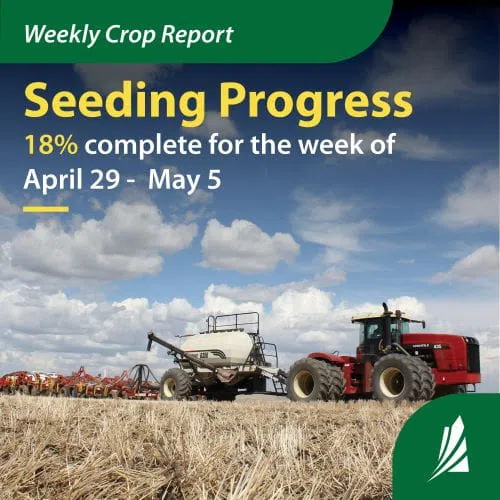
The first Saskatchewan Agriculture crop report of the year puts seeding at 18 per cent complete— well ahead of the ten-year average of 12 per cent.
Much of the work has been done in the southwest where 43 per cent of the crop is in the ground. The northwest and southeast are next at 15 and 14 per cent respectively. West-central is at 11 per cent with the east-central and northeast regions at 9 per cent.
Lentils, peas and durum are going in now with about one-third of each already in the ground.
Provincially, topsoil moisture on cropland is rated three per cent surplus, 78 per cent adequate, 16 per cent short and three per cent very short.
Check out the region-by-region crop report below:
Census Division 1 – Carnduff, Estevan, Lampman, Redvers and Stoughton areas
Census Division 2 – Avonlea, Fillmore, Minton, Radville and Weyburn areas
Census Division 5 – Broadview, Esterhazy, Melville and Moosomin areas
Census Division 6 – Belle Plaine, Cupar, Lumsden, Indian Head, Regina and Rouleau areas
Despite April storms that brought larger amounts of moisture to some areas within the region, the southeast was able to make good progress and is currently reporting 14 per cent of seeding complete. This is ahead of the five-year average (2020-2024) of nine per cent for the region.
Of the crops seeded, chickpeas are the furthest along at 34 per cent seeding completion, closely followed by durum at 33 per cent. Field peas and lentils have reached 22 per cent and 17 per cent seeding completion respectively. Oats are reported at 13 per cent complete, spring wheat at 11 per cent and barley at 7 per cent. Mustard currently sits at five per cent complete, followed by canola at four per cent.
| Southeast Saskatchewan | |
| Census division | % seeded (May 5, 2025) |
| 1 | 26% |
| 2 | 25% |
| 5 | 3% |
| 6 | 5% |
| Region average | 14% |
Rainfall was scattered across the region over the last week. The highest rainfall recorded fell in the Alida area at 16 mm, followed by the Glenavon area at 10 mm and the Avonlea area at 9 mm.
Currently, cropland topsoil moisture within the region is rated as six per cent surplus, 86 per cent adequate and eight per cent short. Hay land topsoil moisture is rated as two per cent surplus, 83 per cent adequate, 14 per cent short and one per cent very short. Pasture is rated at 86 per cent adequate, 12 per cent short and two per cent very short.
Spring runoff was reported in late April, with regional data indicating 21 per cent below normal, 67 per cent normal and 12 per cent above normal. Eighty-four per cent of the crop reporters indicated that the amount of runoff received would be sufficient to replenish dugouts and other water bodies within their area.
Additionally, pasture conditions were also reported in late April, with regional data indicating that six per cent of pastures within the region are reported as excellent, 40 per cent are reported as good, 33 per cent reported as in fair condition, 16 per cent reported as poor and five per cent very poor.
Within the region, producers will continue with their seeding operations, with some areas just starting, along with pre-seed spraying for weed control, harrowing, rock picking, calving, fixing fence and starting to move cattle out to pasture.
Census Division 3 – Assiniboia, Gravelbourg, Mankota, Ponteix and Rockglen areas
Census Division 4 – Cadillac, Consul, Eastend, Maple Creek and Val Marie areas
Census Division 7 – Beechy, Central Butte, Craik, Herbert, Hodgeville and Moose Jaw areas
Census Division 8 – Cabri, Elrose, Fox Valley, Leader, Swift Current and Tompkins areas
The weather over the last couple weeks has supported rapid seeding progress within the region. The southwest region is currently reporting 43 per cent seeding completion with some of the early seeded crops starting to emerge. This is ahead of the five-year average (2020-2024) of 20 per cent for the region.
| Southerwest Saskatchewan | |
| Census Division | % seeded (May 5, 2025) |
| 3 | 37% |
| 4 | 60%/td> |
| 7 | 34% |
| 8 | 44$ |
| Region average | 43% |
Of the crops seeded, triticale is the furthest along in seeding progress at 60 per cent, followed by barley at 52 per cent, field peas at 56 per cent and lentils at 45 per cent. Durum currently sits at 44 per cent complete, chickpeas at 39 per cent, spring wheat at 32 per cent and oats at 13 per cent. Of the oilseed crops, mustard is the furthest ahead in seeding progress at 33 per cent, followed by canola at 30 per cent and flax at 17 per cent. Perennial forage currently sits at 12 per cent completion.
Rainfall was variable throughout the region with the Lafleche area receiving the highest amount at 12 mm. The Aneroid, Limerick, Mossbank and Moose Jaw areas all received 10 mm over the past week.
Currently, cropland topsoil moisture is rated as 76 per cent adequate, 19 per cent short and five per cent very short. Hay land topsoil moisture is rated as 67 per cent adequate, 26 per cent short and seven per cent very short. Pasture is rated at 61 per cent adequate, 33 per cent short and six per cent very short.
Spring runoff was reported in late April, with regional data indicating 52 per cent below normal, 42 per cent normal and six per cent above normal. Fifty-two per cent of the crop reporters indicated that the amount of runoff received wouldn’t be sufficient to replenish dugouts and other water bodies within their area.
Additionally, pasture conditions were also reported in late April, with regional data indicating that 51 per cent of pastures within the region are reported as good, 40 per cent are reported as fair, eight per cent reported as poor, and one per cent very poor.
Producers will continue seeding operations within the region, along with pre-seed spraying for weed control, harrowing, rock picking, calving, fixing fence and moving cattle out to pasture.
Census Division 12 – Biggar, Delisle, Rosetown and Sonningdale areas
Census Division 13 – Cut Knife, Kerrobert, Kindersley, Macklin, Plenty and Wilkie areas
The weather is supporting consistent seeding progress across the west-central region. Currently seeding is reported at 11 per cent complete. This falls in line with the five-year average (2020-2024) of 11 per cent for the region.
| West-Central Saskatchewan | |
| Census Division |
% seeded (may 5, 2025) |
| 12 | 9% |
| 13 | 12% |
| Region average | 11% |
Of the crops seeded, field peas and lentils are the furthest along at 26 per cent and 21 per cent respectively. Durum follows close behind at 17 per cent seeded. Canola currently sits at 11 per cent seeded within the region, followed by spring wheat at nine per cent and canary seed at eight per cent. Barley is reported at three per cent seeded and both mustard and soybeans are reported at one per cent. Perennial forage currently sits at four per cent seeding completion.
Trace amounts of rainfall fell within the region over the past week with the majority of areas receiving no rainfall.
Currently, cropland topsoil moisture is rated as two per cent surplus, 83 per cent adequate, 12 per cent short and three per cent very short. Hay land topsoil moisture is rated as one per cent surplus, 75 per cent adequate, 17 per cent short and seven per cent very short. Pasture is rated at one per cent surplus, 74 per cent adequate, 18 per cent short and seven per cent very short.
Spring runoff was reported in late April, with regional data indicating nine per cent below normal, 64 per cent normal and 27 per cent above normal. Ninety-five per cent of the crop reporters indicated that the amount of runoff received would be sufficient to replenish dugouts and other water bodies within their area.
Additionally, pasture conditions were also reported in late April, with regional data indicating 18 per cent of pastures within the region are reported as excellent, 48 per cent are reported as good, 21 per cent reported as in fair condition, seven per cent reported as poor and six per cent very poor.
Producers will continue seeding operations within the region, along with pre-seed spraying for weed control, harrowing, rock picking, calving, fixing fence and moving cattle out to pasture.
Census Division 9 – Calder, Canora, Pelly, Preeceville, Sheho and Yorkton areas
Census Division 10 – Foam Lake, Kelliher, Leroy, Raymore and Wadena areas
Census Division 11 – Davidson, Colonsay, Langham, Lanigan, Nokomis, Outlook and Saskatoon areas
Producers are making good progress with seeding within the east-central region. Currently seeding is reported at nine per cent complete. This is ahead of the five-year average (2020-2024) of three per cent for the region.
| East-Central Saskatchewan | |
| Census Division | % seeded (May 5, 2025) |
| 9 | 5% |
| 10 | 2% |
| 11 | 16% |
| Region average | 9% |
Of the crops seeded, lentils and field peas are the furthest along at 20 per cent and 17 per cent respectively. Barley is reported at 13 per cent seeded, followed by spring wheat at nine per cent, canola at five per cent, durum at four per cent and oats at two per cent. Perennial forage currently sits at four per cent seeding completion.
Rainfall was limited within the region over the past week. The highest rainfall recorded fell in the Punnichy area, which reported eight mm, followed by the Wroxton area at seven mm.
Currently, cropland topsoil moisture is rated as five per cent surplus, 79 per cent adequate and 16 per cent short. Hay land topsoil moisture is rated as three per cent surplus, 69 per cent adequate, 24 per cent short and four per cent very short. Pasture is rated at three per cent surplus, 64 per cent adequate, 17 per cent short and 16 per cent very short.
Spring runoff was reported in late April, with regional data indicating 26 per cent below normal, 52 per cent normal and 22 per cent above normal. Eighty-three per cent of the crop reporters indicated that the amount of runoff received would be sufficient to replenish dugouts and other water bodies within their area.
Additionally, pasture conditions were also reported in late April, with regional data indicating 16 per cent of pastures within the region are reported as excellent, 31 per cent are reported as good, 23 per cent reported as in fair condition, 28 per cent reported as poor and two per cent very poor.
Within the region, producers will continue with seeding operations, with some areas just starting in the coming week, along with pre-seed spraying for weed control, harrowing, calving, fixing fence and getting ready to move cattle out to pasture.
Census Division 14 – Choiceland, Hudson Bay, Kelvington, Melfort, and Nipawin areas
Census Division 15 – Cudworth, Humboldt, Kinistino, Prince Albert, Rosthern and St. Brieux areas
Seeding is progressing within the region, with some producers anticipating getting into their fields over the next couple of days. The northeast region is currently reporting nine per cent completed seeding. This is ahead of the five-year average (2020-2024) of three per cent for the region.
| Northeast Saskatchewan | |
| Census Division |
% seeded (May 5, 2025) |
| 14 | 10% |
| 15 | 8% |
| Region average | 9% |
Of the crops seeded, lentils and field peas are the furthest along at 19 per cent and 15 per cent respectively. Spring wheat follows close behind at nine per cent seeded. Oats currently sit at five per cent seeded within the region, followed by both barley and canola at four per cent seeding completion. Perennial forage currently sits at two per cent and canary seed at one per cent seeded.
Rainfall was limited throughout much of the region over the past week. The highest rainfall reported was 3 mm in the Smeaton area followed by the Bruno and Rosthern areas at 2 mm.
Currently, cropland topsoil moisture is rated as one per cent surplus, 77 per cent adequate, 21 per cent short and one per cent very short. Hay land topsoil moisture is rated as one per cent surplus, 74 per cent adequate and 25 per cent short. Pasture is rated at 73 per cent adequate and 27 per cent short.
Spring runoff was reported in late April, with regional data indicating 28 per cent below normal, 56 per cent normal and 16 per cent above normal. Eighty-three per cent of the crop reporters indicated that the amount of runoff received would be sufficient to replenish dugouts and other water bodies within their area.
Additionally, pasture conditions were also reported in late April, with regional data indicating one per cent of pastures within the region are reported as excellent, 45 per cent are reported as good, 34 per cent are reported as in fair condition, 11 per cent reported as poor and nine per cent very poor.
Within the region, producers will continue with seeding operations, with some areas just starting in the coming week, along with pre-seed spraying for weed control, harrowing, applying fertilizer, calving, fixing fence and getting ready to move cattle out to pasture.
Census Division 16 – Blaine Lake, Canwood, North Battleford, Radisson and Spiritwood areas
Census Division 17 – Glaslyn, Maidstone, Meadow Lake, Pierceland and St. Walburg areas
Producers are making good progress with seeding within the northwest region. Currently seeding is reported at 15 per cent complete. This is ahead of the five-year average (2020-2024) of seven per cent for the region.
| Northwest Saskatchewan | |
| Census Division |
% seeded (May 5, 2025) |
| 16 | 7% |
| 17 | 25% |
| Region average | 15% |
Field peas and spring wheat are both reported at 27 per cent seeded. Lentils are 14 per cent seeded, followed by canola at 10 per cent and barley at eight per cent. Oats currently sit at three per cent seeding completion.
Trace amounts of rainfall fell within the region over the past week, with the majority of areas receiving no rainfall. The highest amount of rainfall recorded was in the Livelong and Canwood areas, which both reported only two mm over the past week.
Currently, cropland topsoil moisture is rated as one per cent surplus, 53 per cent adequate, 36 per cent short and 10 per cent very short. Hay land topsoil moisture is rated as one per cent surplus, 45 per cent adequate, 37 per cent short and 17 per cent very short. Pasture is rated at one per cent surplus, 45 per cent adequate, 37 per cent short and 17 per cent very short.
Spring runoff was reported in late April, with regional data indicating 53 per cent below normal, 41 per cent normal and six per cent above normal. Fifty-seven per cent of the crop reporters indicated that the amount of runoff received would be sufficient to replenish dugouts and other water bodies within their area.
Additionally, pasture conditions were also reported in late April, with regional data indicating seven per cent of pastures within the region are reported as excellent, 27 per cent are reported as good, 48 per cent are reported as in fair condition, 15 per cent reported as poor and three per cent very poor.