




Some of the noxious weeds found in the northwest of the province, specifically, absinthe, leafy spurge and common tansy.
The following article was written by Andre Bonneau, range management specialist for the Saskatchewan Ministry of Agriculture in Prince Albert.
When you get near an infestation of absinthe or wormwood, a strong scent of sage is one of the first things you notice. The plants are a dusty grey to light green and become noticeable once they grow up past the grass. The flowers look like little grey granules on the stems. We usually find absinthe where pastures may have been pushed a little too hard or near old garden plots. Some early settlers brought it with them from Europe as an ornamental and medicinal plant.
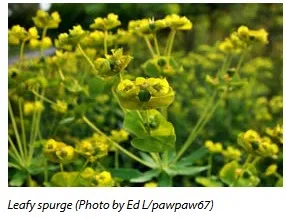
Leafy spurge is a problem in some areas of the north west. Leafy spurge tends to grow in pastures with light soils but will do quite well in almost any soil type. In the late spring or early summer, we’ll see them as yellow flowers in the pasture. Leafy spurge has a strong and deep creeping root system and when you break the stem, you’ll see a milky sap.
You need a lot of patience to control leafy spurge and repeated activity is needed to keep it under control.
Common tansy is also an issue in some areas of the region. Some people call them butter cup and they tend to grow in tall clumps on pastures, along the ditches and around sloughs. They can grow fairly tall, up to three feet. The flowers are bright yellow and are in in a disk at the top of the stem.
One thing in common with these and other noxious weeds is the high number of seeds they produce. Often, you’ll kill the plant but there are so many seeds on the ground that another plant will germinate and take its place. This is why persistent control is important when controlling these and other noxious weeds.
For more information on identifying, managing or controlling noxious weeds, contact the Ag Knowledge Centre at 1 866-457-2377 and they’ll put you into contact with a range specialist in the regional offices.