





Most farmers have completed seeding with only a few greenfeed crops left to go in the ground.
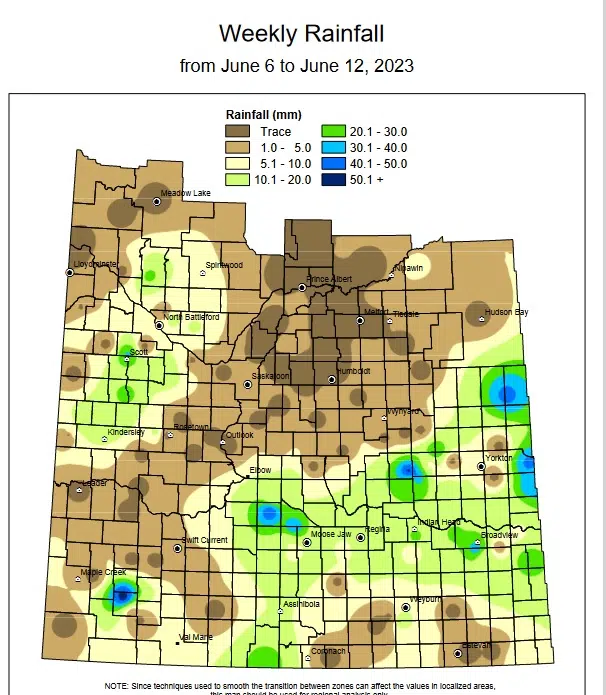
There were several thunderstorms around the province last week (June 6-12) which delivered large amounts of rain to localized areas, such as Foam Lake and Kelliher. There were also many areas, especially in the western half of Saskatchewan, that received minimal precipitation.
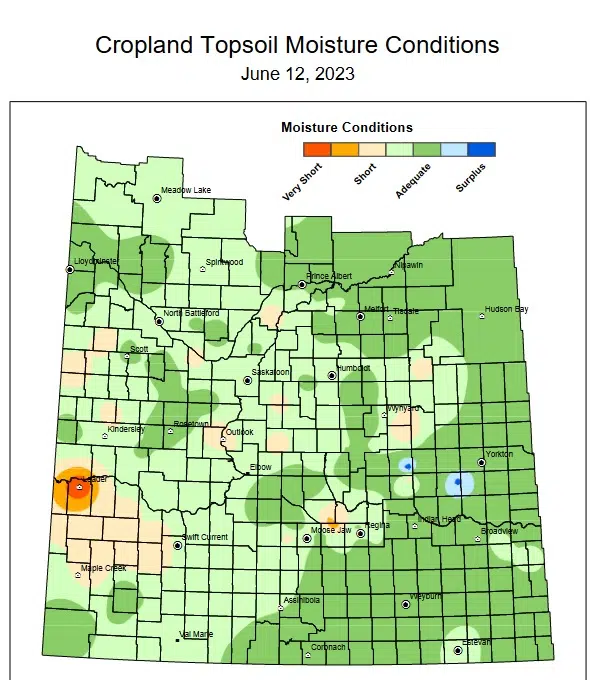
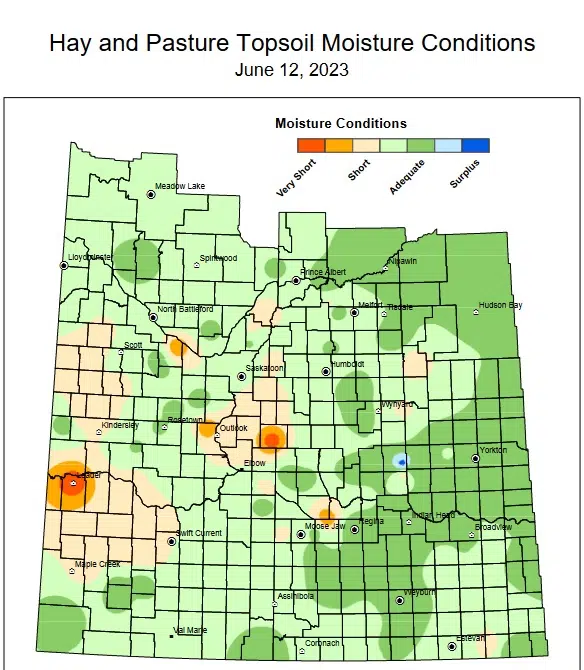
Provincially, topsoil moisture conditions declined slightly over the past week. Cropland topsoil moisture is rated as two per cent surplus, 66 per cent adequate, 28 per cent short and four per cent very short. Hay and pasture land is rated as one per cent surplus, 60 per cent adequate, 33 per cent short and six per cent very short.
Check out the detailed crop report below the maps.
Crop District 1 – Carnduff, Estevan, Redvers, Moosomin and Kipling areas;
Crop District 2 – Weyburn, Milestone, Moose Jaw, Regina and Qu’Appelle areas;
Crop District 3ASE – Radville, Minton and Lake Alma areas
Seeding is almost finished for producers in the region, some will be wrapping up the last of their greenfeed acres and then finally closing the seeding chapter for 2023. Some reseeding is occurring due to grasshopper damage on earlier seeded crops. Producers are hoping they can get ahead on their pest control to reduce to amount of crop lost this year.
There were heavy localized rain showers in the region this past week resulting in some severe flooding. Reported precipitation from rain gauges shows that rainfall ranged from two mm to 35 mm for the week. Some producers have reported anecdotal information that some downpours resulting in three to four inches of rain, these areas experienced heavy flood and has led to crop damage and soil erosion.
Cropland topsoil moisture is rated as three per cent surplus, 83 per cent adequate, 13 per cent short and two per cent very short. Hay and pasture land topsoil moisture is rated as one per cent surplus, 73 per cent adequate, 26 per cent short and one per cent very short. Many producers in the south half of the region are calling for more rain after they missed out on most of the recent precipitation and their fields are beginning to dry out rapidly.
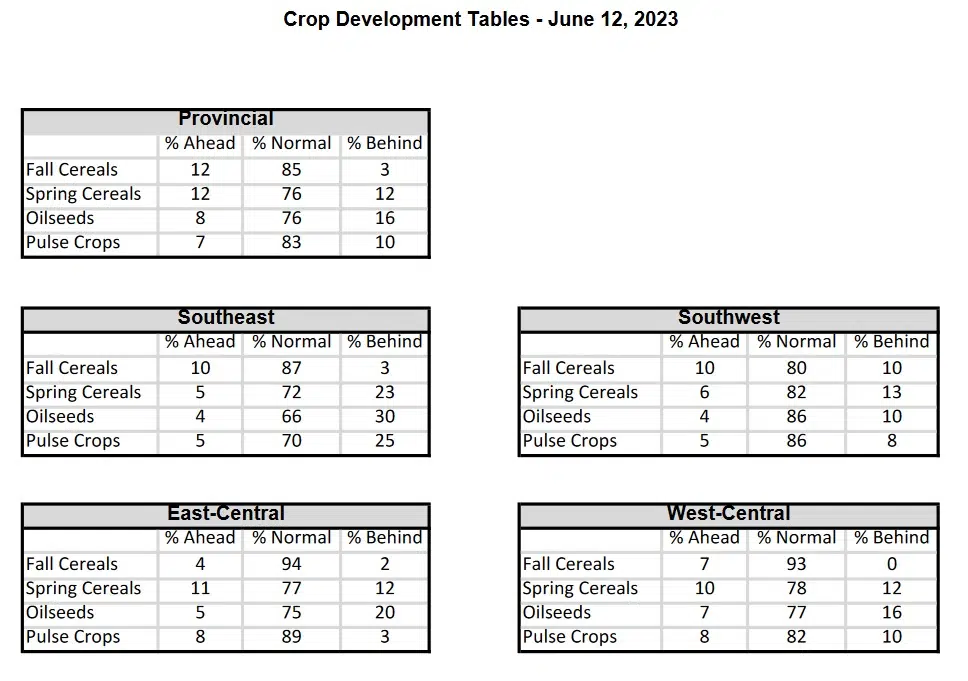
In the southeast region, 87 per cent of the fall cereals, 72 per cent of the spring cereals, 66 per cent of the oilseed crops and 70 per cent of the pulse crops are at their normal stages of development for this time of year. Due to adequate moisture this spring, crops have been developing very well. In the areas where soil moisture was too high, crops have been slow to develop as they struggle through their growing conditions.
Crop conditions range from fair to excellent in the region, with 65 per cent of the spring wheat, 67 per of the canola and 58 per cent of the lentils being in good condition at this time. Producers are hoping for good forecasts as they enter the second half of June, crops will need more moisture now to maintain their yield potential before the hot days of July arrive.
The majority of crop damage this week was due to flooding, insect pests (flea beetle and grasshoppers) and hail. In areas where large amounts of rainfall were received, pulse crops are suffering due to the occurrence of root rot; unfortunately, producers can only hope conditions dry up. Producers are busy spraying when they can and beginning to clean and store their seeding equipment until next year.
Crop District 3ASW – Coronach, Assiniboia and Ogema areas;
Crop District 3AN – Gravelbourg, Mossbank, Mortlach and Central Butte areas;
Crop District 3B – Kyle, Swift Current, Shaunavon and Ponteix areas;
Crop District 4 – Consul, Maple Creek and Leader areas
Seeding has been completed in the region and now producers are working around the clock to protect their young seedlings from hungry pests. Grasshoppers have returned to the region in droves and are beginning to cause crop damage. Some portions of the region received rain this past week while others did not, resulting in a further decline in topsoil moisture and an increase in anxiety around growing conditions.
Heavy, localized rain showers hammered some of the region. In extreme cases, some producers received two to three inches of rain in a matter of hours. The Shaunavon area reported 54 mm and the Eyebrow area reported 47 mm. Flooding occurred and resulted in crop damage and soil erosion. Pulse crops that are now sitting in saturated soils will be at a higher risk of root rot.
Since the rain was so heavy and localized, there was not a widespread increase to top soil moisture in the region. Most producers are calling for a three-day general soaking rain to help improve soil moisture.
Cropland topsoil moisture is rated as 53 per cent adequate, 39 per cent short and eight per cent very short. Hay and pasture land topsoil moisture is rated as 47 per cent adequate, 45 per cent short, and seven per cent very short. Parts of the region are still experiencing conditions similar to the 2021 growing season, the crops in these areas are in desperate need of rain.
Regionally, 80 per cent of the fall cereals, 82 per cent of the spring cereals, 86 per cent of the oilseed crops and 86 per cent of the pulse crops are at their normal stages of development for this time of year. This will quickly reverse if the region does not receive frequent precipitation as the days begin to get hotter.
The majority of crops in the region range from good to poor condition, with 56 per cent of the spring wheat, 56 per cent of the durum, 62 per of the canola and 60 per cent of the lentils being in good condition at this time.
The majority of crop damage this week was due to flooding, insect pests (flea beetle and grasshoppers) and hail. Grasshoppers have been especially bad in the region; some producers have already applied two rounds of pest control products and in some RM’s there are considerations being made around spraying ditches to help control the spread of the pest.
Crop Districts 6B – Hanley, Outlook, Loreburn, Saskatoon and Arelee areas;
Crop District 7A – Rosetown, Kindersley, Eston, Major;
Crop District 7B – Kerrobert, Macklin, Wilkie and Biggar areas
It was another hot, dry week in the west central as many producers missed out on the localized showers that dotted the region. With seeding now complete, producers desperately need moisture to ensure their crops continue their development at a proper pace.
More rainfall is certainly needed in the region. The Wilkie area reported the most with 31 mm and the Kindersley area with 20 mm, producers are noting that some fields received higher rainfall amounts in the range of two to three inches much like other regions of the province. Cropland topsoil moisture is rated as 60 per cent adequate, 35 per cent short and five per cent very short. Hay and pasture land topsoil moisture is rated as 40 per cent adequate, 49 per cent short and eleven per cent very short.
Regionally, 93 per cent of the fall cereals, 78 per cent of the spring cereals, 77 per cent of the oilseed crops and 82 per cent of the pulse crops are at their normal stages of development for this time of year. The region had more adequate moisture this spring than previous years and this has resulted in the crop being able to have a strong start to its growth cycle. More rain will be needed or else the crop will reverse and begin to rapidly decline in the dry, hot growing conditions. Crop conditions range from fair to excellent in the region, with 74 per cent of the durum, 58 per cent of the canola and 66 per cent of the lentils in good condition at this time.
The majority of crop damage this week was due to localized flooding, hail, wind and insect pests such as flea beetle, grasshoppers and cutworms. Producers have been very active in their attempts to keep insect pressure low in their crops to minimize damage.
Crop District 5 – Melville, Yorkton, Cupar, Kamsack, Foam Lake, Preeceville and Kelvington areas;
Crop District 6A – Lumsden, Craik, Watrous and Clavet areas
Seeding has just about wrapped up except for a few fields of greenfeed. Producers saw good germination and emergence in their seeded crops this year due to adequate moisture, while some areas that were overly saturated saw some delayed or uneven emergence. Producers are happy with their growing conditions, and they hope to see them continue.
Like the southern regions, the east central got slammed by rain showers last week which resulted in flooding and low areas once again holding water. Producers have reported rainfall up to 53 mm (Kelliher) and 30 mm (Foam Lake) while reports have also come in of areas receiving more than three inches of rain. Producers are hoping their fields dry out quickly to ensure their crops are not sitting in pooled water for too long. Some areas in the region reported hail along with rain but crop damage has been assessed as minor.
Topsoil moisture continues to remain strong in most areas of the region. Cropland topsoil moisture is rated as six per cent surplus, 59 per cent adequate, 39 per cent short and eight per cent very short. Hay and pasture land topsoil moisture is rated as four per cent surplus, 61 per cent adequate, 27 per cent short and nine per cent very short. Livestock producers would like to see more rain on their hay land to ensure adequate growth before the first cut of hay in a couple weeks.
Crop development is right on track for the region, with 94 per cent of fall cereals, 77 per cent of spring cereals, 75 per cent of oilseeds and 89 per cent of pulses rated as being normal in their development. Producers hope growing conditions remain excellent in the coming weeks. Crop conditions range from fair to excellent in the region, with 72 per cent of the spring wheat, 71 per of the canola and 74 per cent of the lentils being in good condition at this time.
The majority of crop damage this week was due to minor hail, flooding, flea beetles, grasshoppers and gophers. Producers are busy spraying for weeds and insect pests where necessary.
Crop District 8 – Hudson Bay, Tisdale, Melfort, Carrot River, Humboldt, Kinistino, Cudworth and Aberdeen areas;
Crop District 9AE – Prince Albert, Choiceland and Paddockwood areas
Seeding is complete in the region and producers are hoping for more rain soon. The recent rain was appreciated but with the hot days that followed, producers are saying their crops are once again suffering. Crops on lighter soils and hill tops are suffering the most from the dry conditions, more clay textured soils have begun to crack from the dryness.
There were only minor rain showers in the region this week ranging from three to eight mm. Producers hope more is on the forecast to ensure their crops do not start to rapidly decline. Regionally, the cropland topsoil moisture is rated as three per cent surplus, 84 per cent adequate, 12 per cent short and one per cent very short. Hay and pasture land topsoil moisture is rated as one per cent surplus, 85 per cent adequate 13 per cent short and one per cent very short.
Regionally, 59 per cent of the fall cereals, 67 per cent of the spring cereals, 76 per cent of the oilseed crops and 66 per cent of the pulse crops are at their normal stages of development for this time of year. Some crops are ahead due to being seeded earlier than normal and the dry growing conditions. Crop conditions range from fair to excellent in the region, with 64 per cent of the spring wheat, 61 per of the canola and 66 per cent of the peas being in good condition currently.
The majority of crop damage this week was due to flea beetles. Farmers are currently spraying to keep flea beetle damage to a minimum. Producers would like less wind and milder days to help with spraying operations and to get crops growing rapidly.
Crop District 9AW – Shellbrook, North Battleford, Big River and Hafford areas;
Crop District 9B – Meadow Lake, Turtleford, Pierceland, Maidstone and Lloydminster areas
For the Period June 6 to 12, 2023
Seeding is complete and producers report that growing conditions for most of the region are good, however all producers in the region are hoping for more rain. The past week only brought minor rain showers and has been very hot and windy. Producers are worried their crops will begin to suffer, especially those on lighter textured soils.
The only significant rainfall recorded was in the Neilburg area where 24 mm was reported. Besides this, most rain in the region ranged from five to 11 mm. Near the Hafford area, a hail storm rolled through and resulted in enough hail to blanket the ground. Producers in the area assessed the damage and as of right now rated it as minor.
Cropland topsoil moisture is rated as one per cent surplus, 72 per cent adequate, 27 per cent short and one per cent very short. Hay and pasture land topsoil moisture is rated as 64 per cent adequate, 32 per cent short and four per cent very short.
Regionally, 76 per cent of the spring cereals, 85 per cent of the oilseed crops and 84 per cent of the pulse crops are at their normal stages of development for this time of year. Crop conditions range from fair to excellent in the region, with 57 per cent of the spring wheat, 59 per of the canola and 72 per cent of the peas being in good condition at this time.
The main sources of crop damage this week were wind, drought and flea beetles. Producers are now getting into the full swing of in crop spraying for weeds and insect pests.