



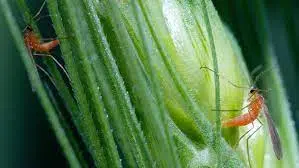
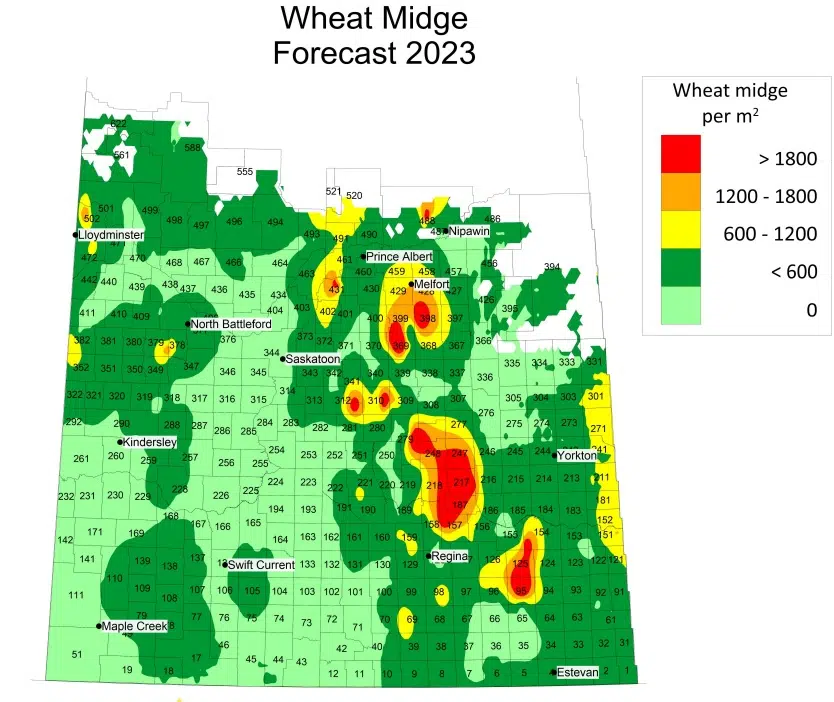
The Saskatchewan Wheat Midge Forecast Map for 2023, based on soil core data from 2022, shows increased numbers of wheat midge as compared to the forecast from the previous year. Rainfall of more than 25 mm in May enhances wheat midge emergence and the potential for damage.
 Meanwhile, the primary insecticide for controlling wheat midge is no longer being sold. In December 2020, the Pest Management Regulatory Agency (PMRA) announced the cancellation of all production and formulation of insecticides containing Chlorpyrifos, the active ingredient in products such as Lorsban, Pyrinex, Nufos and Citadel. Retailers had until December 2022 to sell remaining inventory to producers. 2023 is the last year the product can legally be applied.
The only other chemistry registered for wheat midge control is Dimethoate, available in products such as Lagon and Cygon. Chlorpyrifos was the preferred insecticide and was considered more effective than Dimethoate.
“Wheat midge control with an insecticide is particularly difficult to start with,” notes Kurt Printz, president of the Saskatchewan Seed Growers’ Association. “Extensive scouting is needed to determine whether fields warrant an application and the application window for best control is short. Growing a midge-tolerant variety eliminates the need for scouting, spraying and worrying.”
Wheat varieties with genetic resistance to wheat midge became commercially available more than 10 years ago. Denoted by the VB (varietal blend) designation after their varietal name, many midge-tolerant varieties are now available in all classes of spring wheat as well as durum with all the attributes of the most popular regular varieties.
When research scientists discovered the gene that confers wheat midge tolerance, they realized the need to preserve this defense mechanism. Large acreages of midge-tolerant varieties would put enormous selection pressure on wheat midge to evolve and overcome the tolerance.
The solution is a varietal blend. Each wheat midge tolerant variety includes five to 15 per cent of a variety susceptible to wheat midge. For instance, AAC Hodge VB includes five to 15 per cent AAC Hockley, which is considered the refuge variety. Refuge varieties are chosen to be as similar as possible to the midge tolerant variety – the same height, maturity and disease resistance.
Having the refuge variety greatly decreases the selection pressure for wheat midge to overcome the tolerance gene. However, it also means that growers can’t grow generation after generation of farm-saved seed since the refuge variety is likely to decline over several generations.
The technology must be preserved because there is no plan B. No other genetic resistance is known.
Farmers buying certified seed of a varietal blend are required to sign a stewardship agreement whereby they promise to only keep seed for one generation past certified. On the surface this may seem to indicate the need for new seed every second year, but that’s not actually the case. A producer can bin a multi-year supply for their own use from their first year of production.
“Since wheat midge damage has not been severe in recent years, we’re worried that producers may not be taking the threat as seriously as they should,” says Printz, a seed grower from the Gravelbourg area. “Based on the forecast map, damage could be significant in many areas. More than ever, the best defense is genetic resistance.”
The 2023 Saskatchewan Seed Guide is the best source of information on registered varieties. The Interactive SaskSeed GuideTM at https://saskseed.ca/interactive-seed-guide/variety-tool/ allows producers to find Certified seed growers for all available varieties.
(Above is a news release from the Saskatchewan Seed Growers Association)