




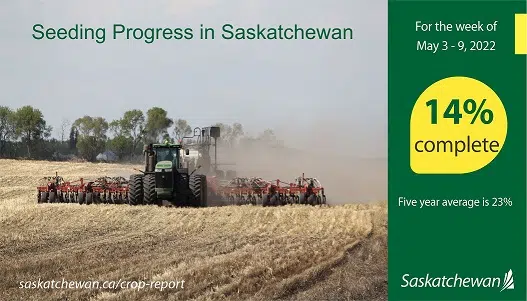
The weekly provincial crop report indicates 14 per cent of the provincial crop had been seeded as of Monday—up from one per cent the previous week and well behind the five-year average of 23 per cent.
The greatest progress was made in the dry southwest and west-central regions where 34 per cent and 20 per cent of the crop is the ground respectively. Seeding progress for the rest of the province is southeast (7 per cent), northwest (5 per cent), east-central (3 per cent) and northeast (1 per cent).
Many Saskatchewan farmers would love to swap weather forecasts. Another significant rain event is forecast for Thursday evening and Friday (May 12-13) over the eastern third of the province.
“The precipitation just seems to not want leave the southeast or the eastern half of the province,” said Matt Struthers, a provincial crops extension specialist with the Saskatchewan Ministry of Agriculture. “The rain is good after a very dry year, but farmers need to get out there and start seeding. I know a lot of them are very anxious to get into their fields.”
The west-central region is the driest in the province with cropland topsoil moisture rated as 20 per cent adequate, 51 per cent short and 29 per cent very short. Some pastures are not growing fast enough and livestock producers say they will not be usable until June if rain is not received soon. Dugouts have experienced poor recharge and water quality is a concern.
The northeast has the most moisture with 15 per cent of cropland rated surplus, 84 per cent adequate and only two per cent short. General field work is still at least a week away in some areas.
The region-by-region crop report summaries can be viewed below:
SOUTHEAST
More and more producers in the region have been able to get into their fields and begin their seeding operations, mainly in the west half of the region. Seven per cent of the crop is now in the ground which is well behind the five-year average (2017-2021) of 27 per cent. Producers in the east half of the region are waiting for their fields to dry out enough so they can begin their seeding and spraying operations.
A large weather system moved through the region over the past week bringing with it some significant amounts of rain in some areas. The Bienfait area received 46 mm, the Outram and Redvers areas 32 mm and the Moosomin and Tantallon areas received 28 mm. This rain will continue to improve topsoil moisture and refill dugouts, but it will also cause further delays to many producers.
The recent precipitation has greatly improved the topsoil moisture conditions for much of the region, especially the far southeast corner around the Carnduff area. Cropland topsoil moisture is rated as 16 per cent surplus, 76 per cent adequate, six per cent short and two per cent very short. Hay and pastureland is rated as four per cent surplus, 77 per cent adequate, 17 per cent short and two per cent very short. The recent rain will help pastures grow rapidly and fill dugouts.
There is not much field activity due to wet field conditions, most of the work is being done in the west half of the region where seeding and spraying is underway.
SOUTHWEST
Producers across the southwest were able to keep their seeding operations going this past week with only minor delays due to rain. Thirty-four per cent of the 2022 crop is now in the ground, which is just slightly ahead of the five-year average (2017-2021) of 29 per cent. Conditions are incredibly dry and producers are noting the amount of dust created during seeding. Rain is needed to provide adequate moisture for germination and plant establishment.
Much of the region received precipitation this past week from 1.5 mm in the Consul area to 26 mm in the Shaunavon area. The Gull Lake area received 23 mm, the Hazenmore area 18 mm and the Vanguard, Mossbank, and Swift Current areas received 16 mm.
With the recent rainfall in many parts of the region, topsoil ratings slightly improved but are still not at adequate levels to support good germination and pasture growth. Cropland topsoil moisture is rated as 46 per cent adequate, 36 per cent short and 18 per cent very short. Hay and pastureland is rated as 39 per cent adequate, 38 per cent short and 23 per cent very short.
Producers are busy testing water sources on their pastures to ensure the quality is safe for their livestock. They are also moving more cattle to pastures that were the first to green up this spring. Windy conditions have stalled many spraying operations and they are likely going to have to wait till after seeding to take care of the weeds in their fields.
EAST CENTRAL
Seeding is delayed in most parts of the region; snow has been slow to melt and recent large rainstorms have left the fields very wet. Currently, three per cent of the 2022 crop is now in the ground, this is just behind the five-year average (2017-2021) of nine per cent. Seeding may be in full swing by next week.
Many parts of the region received good amounts of rainfall. Amounts varied but the most was received in the Pelly area with 49 mm, the Kelvington area 36 mm, the Esterhazy area 28 mm, the Calder area 18 mm and the Bethune area 13 mm. This rain has further delayed field activities but has allowed for creeks to flow, dugouts to fill and pastures to green up.
Moisture levels have improved slightly with recent heavy rains in much of the region. Cropland moisture levels are rated as seven per cent surplus, 71 per cent adequate, 21 per cent short and one per cent very short. Hay and pastureland are rated as five per cent surplus, 61 per cent adequate, 27 per cent short and seven per cent very short. Soil moisture appears to be more than adequate for seed germination and there should not be any moisture concerns in the far east portion of the region for the time being.
Livestock producers have been busy finishing branding so they can move their cattle to pasture, there is little concern over water availability for livestock due to good runoff and heavy rains. Spraying is being done in the western half of the region and seeders are following close behind, almost all producers are seeding in this part of the region.
WEST CENTRAL
Seeding is advancing quickly due to very dry conditions and warm weather. 20 per cent of the crop is in the ground, well ahead of the five-year average (2017-2021) of 13 per cent. Mostly cereals and pulses have been seeded so far with some producers beginning to seed canola. There have been reports of shortages of pulse inoculants across the region which may lead to delayed seeding or poor crop establishment. Soil conditions are extremely dry in the region and producers are concerned their seed could blow away in the wind or not germinate. Rain is needed in the region.
Little rain was reported for the region over the past week, the Outlook area received the most with 18 mm reported, followed by the Hanley and Eyebrow areas with 12 mm. Most of the region received one to two mm of rain which will do very little to improve their moisture conditions. Producers need to be careful while conducting field activities in dry conditions due to the high chance of grass fires being caused by sparking or hot equipment.
Topsoil moisture conditions are very poor in the region and producers are hoping for widespread rain. Cropland topsoil moisture is rated as 20 per cent adequate, 51 per cent short and 29 per cent very short. Hay and pastureland are rated as 13 per cent adequate, 56 per cent short and 31 per cent very short. Some pastures in the region are not growing fast enough and some producers predict they won’t be useable until June if rain is not received soon. Dugouts through the region experienced poor recharge and water quality is already a concern to livestock producers.
Producers who can, have started moving their herds to pastures as feed supplies begin to dwindle. Producers are busy spraying pre-seed herbicide and picking rocks to prep fields for seeding.
NORTHWEST
Seeding is under way throughout the southern half of the region with most of the northern half still waiting for field conditions to improve enough to begin field work. Five per cent of the crop has been seeded, which is behind the five-year average (2017-2021) of 12 per cent. More producers will begin seeding in the next week to ten days.
Small, scattered rainstorms occurred over the week, resulting in some minor precipitation. The most was received in the St. Walburg areas with seven mm, the Meadow Lake, Prince Albert and Spiritwood areas received five mm and several areas in the region reported one to three mm of rainfall.
Recent warm weather has allowed pastures to green up and producers who were struggling with on-farm feed supplies are now moving cattle to pasture while in the north parts of the region, pastures will not be ready for two to three more weeks. Cropland topsoil moisture conditions are rated as four per cent surplus, 62 per cent adequate, 32 per cent short and three per cent very short. Hay and pastureland is rated as two per cent surplus, 60 per cent adequate, 26 per cent short and 12 per cent very short.
NORTHEAST
Very little seeding has occurred in the region due to excessively wet field conditions, one per cent of the 2022 crop has been seeded in the region this is behind the five-year average (2017-2021) of six per cent. The crops that have been seeded so far are mostly wheat and pulses such as field peas.
There were good amounts of rainfall reported across the region this past week, causing further delays to field work being conducted. The Nipawin area received 44 mm, the Garrick area 37 mm, the Lake Lenore and Melfort areas 24 mm and the Hudson Bay area 16 mm. This precipitation will continue the recharge of dugouts and other water bodies and help ensure cattle have adequate water supplies as we move into the summer.
Pastures have been slow to green up in the region and cattle producers hope to have the rest of their cattle out grazing soon. Topsoil moisture conditions this week are rated as 15 per cent surplus, 84 per cent adequate and two per cent short. Hay and pasture levels were rated as seven per cent surplus, 89 per cent adequate and four per cent short.
Most producers are still waiting for snow to melt or fields to dry. General field work is estimated to be a week away.