




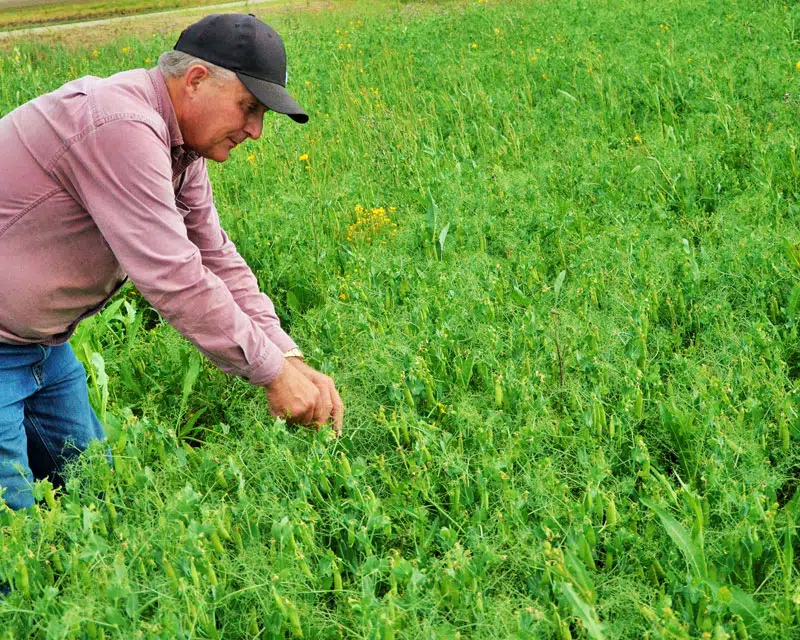
Do you grow greenfeed as part of your winter feeding program? Have you ever considered adding peas to the cereal crop?
Jenifer Heyden, Livestock and Feed Extension Specialist with Saskatchewan Agriculture’s regional office in North Battleford has details you might need to know.
As equipment gets rolling in the fields have you come up with a winter feeding plan? Cereal greenfeed is a viable winter feed source for beef producers across the prairies. Depending on harvest parameters, it can be a nutrient dense feed with adequate protein and ample energy to maintain the herd, at least through mid-pregnancy. However, for mature cows in late gestation or lactation stages or for growing replacement heifers, crude protein in cereal greenfeed is often too low and too high in pea greenfeed. Thus, the inclusion of peas into cereal greenfeed has the potential to provide an adequate amount of protein under most production circumstances. Mixing field peas with a cereal grain for forage has become more common. The primary benefit of peas mixed with cereals is to improve quality, along with a possible boost in yield.
In 2016 and 2017 projects researching the intercropping of peas and cereals for greenfeed were carried out at Saskatoon, Melfort and Swift Current. Barley, oats and peas were seeded in monocultures (alone) and in pea:cereal mixtures, with nitrogen (N) fertilizer application rates of either 60 kg of N/ha or no N applied. Pea-cereal mixtures had a yield advantage and less lodging compared to the monocrops. As expected, the crude protein content of the pea monocrop was higher in CP than required, whereas the CP content of the oat and barley monocrops were too low. The pea-cereal mixtures had an adequate amount of CP to sustain both mid-and-late pregnancy beef cows and replacement beef heifers. However, lactating cows would require an additional protein supplement to meet their requirements when they have a calf at side. As cereal crops mature, neutral detergent fibre, (NDF), the fibre that limits physical intake, increases and dry matter consumption can be reduced. In this study, NDF was lower in pea-cereal mixtures versus the monocrops, removing any potential physical limitations and resulting in an increase in dry matter intake.
So what does all this mean? Including peas into your cereal greenfeed has advantages, including improvements in yield, crude protein and dry matter intake. These improvements present great opportunities for beef cattle producers, providing them the ability to reduce the need for some grain or supplements in winter rations by feeding the better quality forage created by intercropping pea with cereals for greenfeed.
That was information provided by Jenifer Heyden, Livestock and Feed Extension Specialist with Saskatchewan Agriculture’s regional office in North Battleford.
For more information on this or other livestock and feed related topics, contact your nearest Regional Office, visit www.saskatchewan.ca/agriculture or call the Agriculture Knowledge Centre at 1-866-457-2377.