




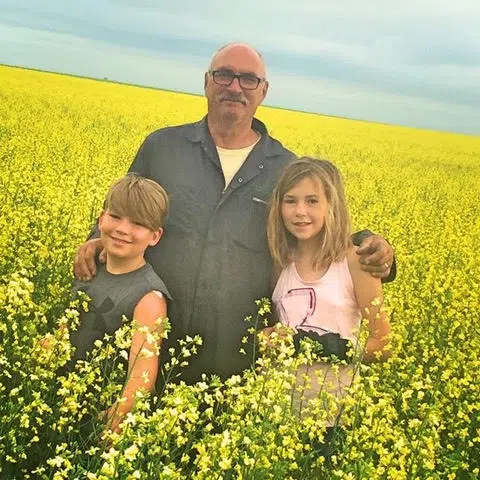
Bob Worth has farmed for more than three decades, about 40 kilometres southwest of Saskatoon.
In September 2013, Bob was diagnosed with multiple myeloma, a little-known and incurable blood cancer of the plasma cells.
“There was pain in my neck and ribs,” said Worth, who was 58 years old at the time. “There was also fatigue and a bit of dizziness.”
An earlier case of bladder cancer in 2003 was treated with surgery. It had been diagnosed in the early stages and a small tumour was removed with no complications. The treatment for the bone marrow blood cancer would be an on-going process.
The first stage was harvesting his healthy stem cells.
“I was very fortunate that I was in probably first stage myeloma and I could use my own stem cells,” said Worth.
The pre-harvest stage lasted three months prior to the stem cell transplant done in Saskatoon. Worth says it wasn’t ”an overly painful process.” He was in hospital for 17 days, six less than doctors anticipated.
Worth was released from hospital toward the end of the 2013 harvest. He was able to ride in the grain truck, but didn’t get in and out. The recovery went well and about a week later, Bob was able to go hunting and came back with a moose.
Stem cell recipients require ongoing treatment with a drug called Revlimid.
“It’s an ongoing treatment because this cancer cannot be cured. It’s a maintenance drug. They say when you have a stem cell (procedure) it could be five years before the cancer comes back again. Revlimid keeps it in check.”
Regular blood tests showed good results until this spring, roughly about five years after the stem cell transplant. There is the possibility of a second stem cell transplant.
“The test results are back up between 4 and 4.5,” said Worth. “The doctors don’t like to see it go any higher than 4.5. My numbers have been steadily going up and that’s one of the signs.”
Judi Worth, Bob’s wife, has become actively involved Myeloma Canada.
“We feel so lucky to have access to these new drug therapies. Without them, Bob would not be here,” said Judi. “Thanks to all of the research being done, there are more treatments and medications available than ever before to help control the myeloma and give Bob a better quality of life.”
Myeloma is the second most common form of blood cancer. Eight Canadians are diagnosed every day. While there is no cure, people with myeloma are living longer and better lives due to improved treatments. Life expectancy has more than doubled in the past 15 years and is continuing on an upward trend.
“For the first time, we can actually say that we’re getting closer to finding a cure,” said Dr. Julie Stakiw, principal investigator at the Saskatoon Cancer Centre. “Investing in research is critical, which is why raising funds is more important than ever.”
Bob and Judi Worth will be among those participating in the Multiple Myeloma March in Saskatoon on Sunday, September 29th. It will be one of 28 events across the country with a national goal of raising $550,000 for new research.
The Saskatoon march will be held at 2:30pm at the Zion Lutheran Church. Participants will walk or run five kilometres.
You can listen to Bob Worth’s full interview here or make a donation at www.myelomamarch.ca
(photo–Bob Worth and his grandchildren in a canola field)