




The following article was prepared by Dwayne Summach, the livestock and feed extension specialist with the Saskatchewan Ministry of Agriculture in Kindersley.
When the time comes to turn the cows and calves out to pasture, it is a great opportunity to tackle the challenge of minimizing production losses caused by pesky, persistent parasites. Internal parasites, such as roundworms and coccidia, live inside the gastroinestinal tract. External parasites such as lice and flies live on, or around the animal. The impact caused by each parasite depends upon the production system, the climatic conditions and the total parasite burden.
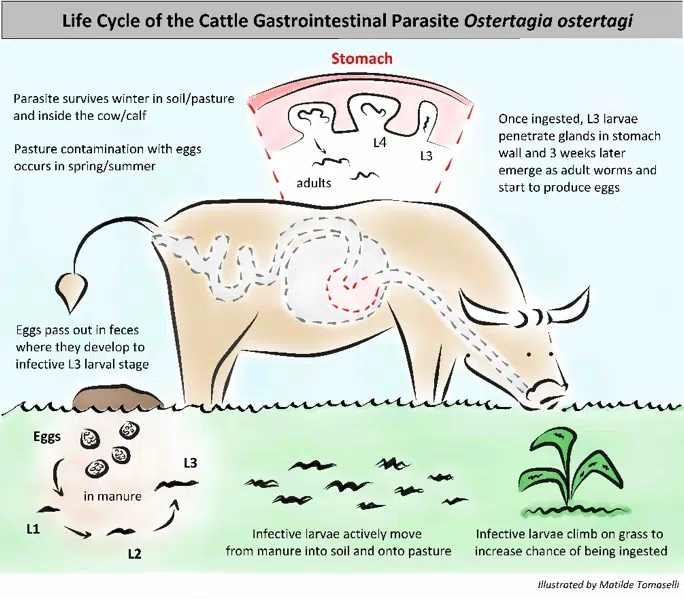
Round worms are likely to be the internal parasite of greatest concern. Sampling a portion of the cows in the spring for faecal egg counts can provide an indication of the parasite load of the herd going to pasture. It is important to chose a deworming product that works well, apply it at the correct time, and in the right amount. Due to the development of parasite resistance to treatments such as ivermectin, it is important to follow up in two weeks with another round of faecal egg counts to make sure the treatment was effective.
Strategies for minimizing the development of resistance and maximizing production gains include leaving ten to twenty percent of the best conditioned cattle untreated, reducing the selection pressure for macrocyclic lactone resistant parasites. Another strategy includes using a a macrocylic lactone, such as ivermectin, moxidectin or doramectin, in combination with fenbendazole.
Horn Flies are highly likely to be the visible, external parasite while the cows are at pasture. Economic thresholds for horn fly populations are estimated at 100 flies per side of the animal. Altosid Insect Growth Regulator is now registered for use in Canada and is a viable alternative to traditional fly control methods. The key to a successful fly control program with Altosid IGR, is consumption of the correct amount of product, for a prolonged period of time – 30 days before fly hatch until 30 days after the first fall frost. It is important to note that this product does not eliminate all the horn flies, but significantly lowers the fly population by interfering with the flies’ reproductive cycle, preventing larvae from developing into adults.
For more information on controlling parasites, contact your local veterinarian, Livestock and Feed Extension Specialist, or call the Agriculture Knowledge Centre at 1-866-457-2377