



The third Canadian Wild Pig Summit is underway in Brandon, bringing together researchers, government officials, industry representatives and wild pig control specialists from across Canada and around the world. Wayne Lees, Coordinator for Squeal on Pigs Manitoba, says the two day event has become an important forum for sharing information and coordinating efforts to manage one of agriculture’s most challenging invasive species.
(The following article was written by Glenda-Lee Vossler of SwiftCurrentOnline)
The summit was launched three years ago to bring together provincial wild pig control programs, federal agencies and industry stakeholders to discuss surveillance, control and eradication strategies. According to Lees, the collaborative approach has helped jurisdictions learn from each other’s successes and challenges.
“This will be the third National Wild Pig Summit to be held in Brandon,” said Lees. “We brought together all of the different provincial wild pig control programs in one place, along with the federal folks, so that we could start to share information and share experiences about our wild pig control efforts.”
Canadian Invasive Wild Pig Report
Animal Health Canada’s 2024 Canadian Invasive Wild Pig Report shows locations of wild pigs and where field activities are focused. Localized established populations of wild pigs currently exist in the three prairie provinces.
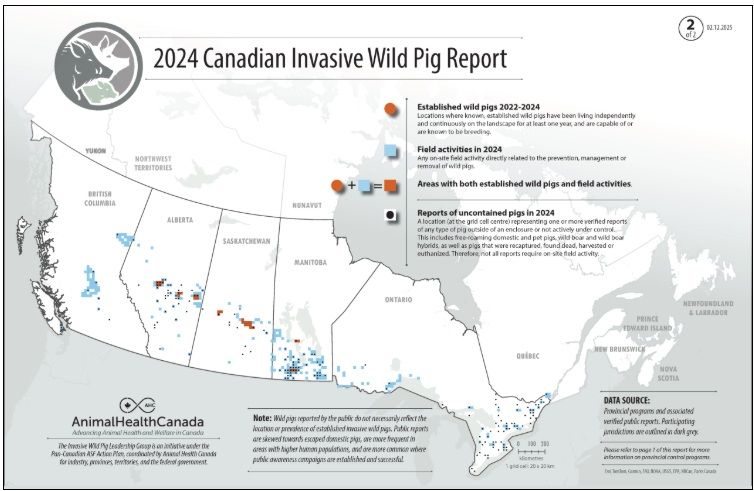
According to the report authorities now describe Saskatchewan’s population as being confined to two small areas and significantly reduced through control efforts, while Manitoba officials continue to focus on two known breeding populations and maintain eradication as a realistic objective.
- The report suggests Saskatchewan’s wild pig problem has been significantly reduced in recent years.
- According to the report, surveillance data from 2020-2024 indicates that a combination of harsh winters and ongoing control efforts has substantially lowered populations.
- Through the Saskatchewan Crop Insurance Corporation (SCIC) Feral Wild Boar Control Program, more than 1,000 wild boars were removed between 2017 and 2025.
- Saskatchewan introduced new regulations in 2024 requiring wild boar farms to be licensed and inspected, while also imposing a moratorium on new wild boar farms.
Wild pigs continue to be a concern because of the damage they can cause to agricultural land, natural ecosystems and livestock production. Lees describes the issue as a “One Health” challenge because it affects multiple sectors simultaneously.
“Wild pigs are what I call a one health problem, because they affect environmental health in the damage to the environment, and that includes crop damage as well. They can affect animal health, in that they can carry diseases that could be spread to other animals. And they’re a public safety hazard as well,” he said.
African swine fever preparedness a key topic
A major focus of this year’s summit is emergency preparedness and response planning related to African Swine Fever (ASF). While the disease does not affect humans, it is highly contagious among pigs and could have devastating consequences for Canada’s pork industry should it ever enter the country.
Summit presentations will include speakers from Alberta, Saskatchewan and Manitoba, along with experts from the United States and Australia. Sessions will examine disease response planning, lessons learned from wild pig management programs and successful eradication efforts in other jurisdictions.
“It’s going to be focusing on emergency preparedness and response, again, focusing on that threat from African swine fever, because that would be a devastating event for the swine industry in Canada if that was ever to arrive here,” said Lees.
Among the international perspectives will be a presentation on the successful eradication of wild pigs from Kangaroo Island in South Australia, along with case studies from the United States.
Technology improving detection efforts
Advances in technology are also changing how wild pig populations are monitored and controlled.
Lees says thermal-imaging drones have become one of the most valuable tools available to field technicians. The equipment allows crews to quickly survey difficult terrain, locate animals and respond more effectively to reported sightings.
“The drone technology has been a game changer for us,” said Lees, noting that portable thermal-imaging units now allow technicians to search areas that would otherwise be difficult to access on foot.
Wild Pig Locations in the Prairies
Animal Health Canada’s 2024 Canadian Invasive Wild Pig Report shows thee most established wild pig populations remain concentrated in the Prairies.
- The largest continuous range is in Saskatchewan, particularly through the forest fringe and parkland belt. Through the Saskatchewan Crop Insurance Corporation (SCIC) Feral Wild Boar Control Program, more than 1,000 wild boars were removed between 2017 and 2025. Saskatchewan introduced new regulations in 2024 requiring wild boar farms to be licensed and inspected, while also imposing a moratorium on new wild boar farms.
- Manitoba has two known significant populations of invasive wild pigs near Spruce Woods Park, southeast of Brandon and near Peonan Point on the northern shore of Lake Manitoba. The report notes Manitoba’s cold climate limits wild pig population growth. Pigs form smaller groups, mature more slowly, and produce fewer offspring than populations in warmer regions such as the southern United States. Because of these factors, the report states that eradication in Manitoba is considered an achievable goal.
- Alberta has more scattered populations, with active eradication and surveillance programs in several central and north-central regions. Wild boar are classified as pests under Alberta legislation, and farming of wild boar has largely been phased out except for a limited number of grandfathered operations. Alberta prohibits recreational hunting of wild boar because it can scatter sounders and make control more difficult. Instead, the province relies on the Alberta Wild Boar Control Program, which uses monitoring, trapping, disease surveillance, and partnerships with municipalities and producers.
Reporting a Wild Pig Sighting

Members of the public are encouraged to report wild pig sightings to their provincial control programs. To report a wild pig, contact a local wild pig control program in your area.
Manitoba
Squeal on Pigs Manitoba
- Website can be found here.
- Report sightings: 1-833-SPOT-PIG (1-833-776-8744)
Saskatchewan
Saskatchewan Crop Insurance Corporation (SCIC)
- Feral Wild Boar Control Program
- Online reporting form
- Report sightings: 1-888-935-0000
Sask Pork Reporting
- Wild boar hotline: 1-833-PIG-SPOT
- Works with SCIC and provincial partners on detection and response.
Alberta
Alberta Invasive Species Council (AISC) – “Squeal on Pigs”
-
- Website can be found here.
- Report sightings:
- 310-FARM (3276)
- wildboar@gov.ab.ca
- EDDMapS reporting app
Alberta Pork – Squeal on Pigs Program
- Website can be found here
- Reporting options and producer resources.