




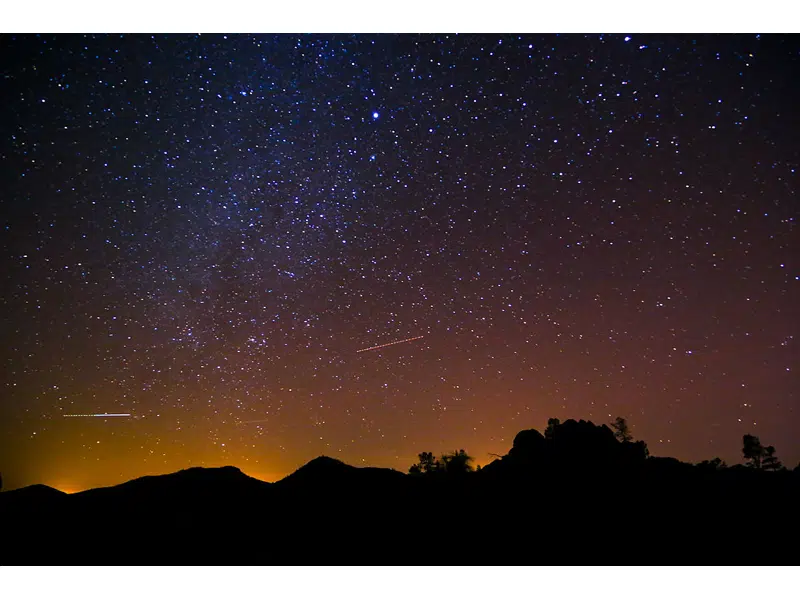
A planet parade will grace the night sky tomorrow evening shortly after the sun sets.
Tim Yaworski, a member of the Royal Astronomical Society of Canada, says that six planets will form a line in the night sky.
“Of course we’ve got our eight planets that orbit around the sun, and every once in a while where their position is, in their orbit, lines up almost like a straight line in a corridor. If we’re looking out into space, they’re all within our field of vision. That’s kind of what’s unique about this.”
Yaworski says that people with less experience in watching the sky will have an easier time finding the planets if they can locate Venus.
“Once the sun goes down, within about 20 minutes after sunset, when we start getting a little bit of a twighlight in the sky. Right near the horizon, you’re going to see a very bright looking star. That would be the planet Venus.”
Yaworski says that Mercury will be faintly visible to the right of Venus, with Jupiter being visible higher up and to the south. He says the other planets will be part of the path, including Uranus, which will not be visible with the naked eye. Saturn and Neptune will be visible closer to Venus.
Along with the planet parade, Yaworski says there will be a total lunar eclipse in the early morning of March 3rd.
“When it hits the full totality, that’s just at 5:04 in the morning, the moon itself will look like a blood red moon, it won’t look like what we’re used to. It’s going to be sort of deep in the shadow but because of the way light curves around things, the light that’s curving around our atmosphere is going to make it look like it’s blood red.”
The lunar eclipse will last until around 6:02 am. As for the planet parade, Yaworski says it will be visible in the sky for a few nights following February 28th.