




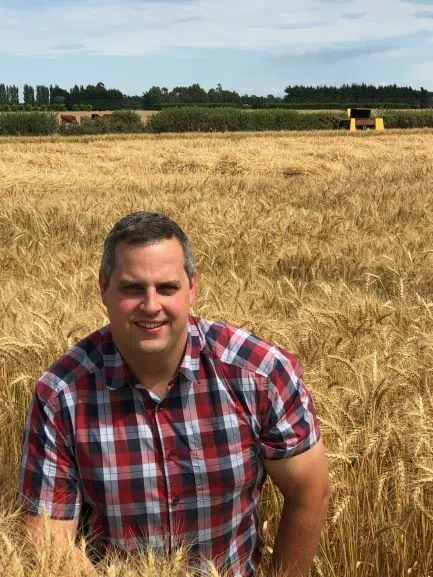
Richard Cuthbert will depart at the end of the month after recently submitting his resignation. Cuthbert took over the wheat breeding program from Dr. Ron DePauw nearly fifteen years ago. These developments have raised concerns from wheat producer organizations. The following article was written by Glenda-Lee Vossler of Swiftcurrentonline.
Leadership loss in critical breeding program
Darcy Pawlik, executive director of the Wheat Growers, described Cuthbert as “one of our best and brightest wheat breeders whom all of Western Canadian farmers really rely on for the genetics that get planted every year.” His expertise, Pawlick said, represented rare institutional knowledge.
“A wheat breeding program is a mix of art and science,” he explained, noting the deep understanding breeders develop over years, not only of genetic lines but also of how those lines perform in different conditions. “It’s a huge risk to the future of Canadian agriculture, because a transition is one thing we can handle. Having quick losses like this, there’s no real way to quickly overcome that.”
Pawlik likened plant breeding to raising children, saying it takes seven to ten generations of planning and execution to create a new variety. He also criticized what he called a lack of succession planning within the federal program, compared with private sector seed companies.
SeCan’s Business Manager for Western Canada, Todd Hyra, says the departure of Cuthbert comes as a surprise and could have wide-reaching impacts for farmers.
“That program, he and his team have been such an important part of not only our lineup, but all of Western Canada’s,” Hyra said. “Anybody growing CWRS, there’s a pretty good chance that they’re growing one of the products that came out of that program (in Swift Current).”
Concerns are also being amplified by broader discussions around federal budget reductions.
Hyra says uncertainty around staffing is especially troubling given the scale of the program’s contributions to Canadian wheat production.
“Ag Canada, as a whole, provides over 85 per cent, maybe even approaching 90 per cent, of the total CWRS varieties in Western Canada. Ag Canada Swift Current would be probably 80 per cent of that on its own.”
Hyra says when a program has the momentum, you want to make sure that there’s a good, solid plan that’s not going to leave a void or a gap that could impact not only seed growers, but every farmer in Western Canada that grows wheat.
He feels the loss could leave a significant gap in the industry and in new varieties if the position is not filled quickly.
“It’s come as quite a shock and could be quite a blow,” he said. “We’re hoping that Canada is able to move quickly and fill that void and ensure that the breeding program continues and is as viable and impactful as it has been for the last 40 years.”
Industry leaders call for clarity, consultation
Pawlik raised broader concerns about federal budget cuts and transparency around research priorities.
“There’s a bit of a transparency problem; we don’t have a great understanding of what’s going on any longer,” he said, adding that farmers and industry stakeholders have not been consulted on how changes will play out.
He suggested that producer organizations and commodity commissions, which collect levies that fund research, should be involved in discussions about the future of breeding programs.
Pawlik also noted challenges related to funding and commercialization, saying scientists have been pushed to secure secondary funding as government support declined.
Sask Wheat warns of long-term impacts
Jake Leguee, chair of the Saskatchewan Wheat Development Commission, said Cuthbert’s resignation was a surprise and a loss for producers.
“The work that he’s done has been really tremendous,” Leguee said, noting Cuthbert’s significant contributions to the development and commercialization of many wheat varieties grown across Western Canada. “Some of those have made up significant market shares, so the loss, I would say, really can’t be overstated.”
Leguee expressed concern about the broader context of AAFC staffing and budget cuts, noting he has spoken with federal ministers about the plans to re-evaluate programming and staffing.
“We’re very concerned about the cuts that AAFC is being forced to make,” he said, adding that breeding stations and scientific capacity can only be reduced so far before the quality of work suffers.
Leguee said the Saskatchewan Wheat Development Commission and its partners are monitoring the situation and analyzing options to improve the long-term stability of Canada’s breeding system.
“What producers need is stable funding for our breeding programs, and these cuts have impacts … it takes 10 to 15 years to get a wheat variety from its first cross to full commercialization,” he said. “What we don’t want to see is a gap somewhere along the way of not having anything new coming out that’s attractive.”
He said filling the position in Swift Current is critical. “We need these positions. They’re absolutely critical to the entire breeding program in Western Canada. Swift Current is a key breeding site, and the position that Richard had is critically important.”
Cuthbert began his career with AAFC Swift Current in 2011. He notes he has thoroughly enjoyed working alongside the breeding team, his co-workers, farmers and the industry as a whole.