




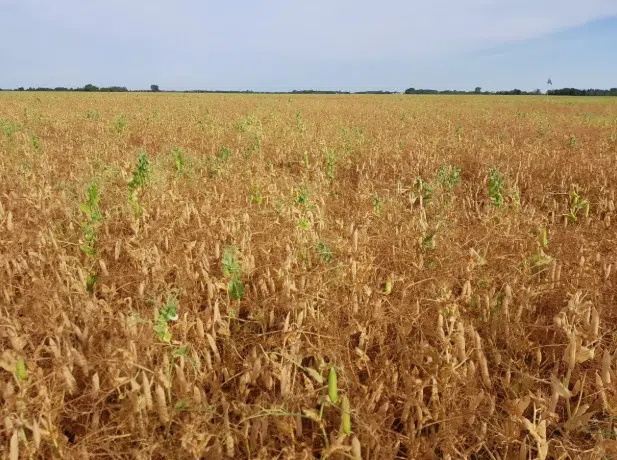
August rain has improved topsoil moisture conditions, but it is all creating staging issues on crops that did not receive much precipitation during the growing season.
Desiccants are contact herbicides designed to quickly dry down the crop, which helps improve uniformity and make harvest easier by reducing late weed growth, uneven ripening, and crop lodging.
The following article was prepared by Ashley Kaminiski, crop specialist with the Saskatchewan Ministry of Agriculture in Humboldt.
When spraying, it is important to spray for the majority of the crop. If possible, try to avoid areas of the field that are significantly delayed. Let them mature before returning to finish desiccating. For most crops you’ll want the seed moisture level to be 30 percent or less before spraying. Check the product label for recommended moisture content. Spraying too early can risk exceeding residue limits and affect the quality of your crop.
For straight cut canola varieties, apply desiccants when at least 60 to 80 percent of seeds have changed color. And if you’re growing pod shatter tolerant varieties, you can let those dry down naturally if time allows.
In cereals, pre-harvest glyphosate is used to help control perennial, winter annual, and biennial weeds, making harvest easier. It should be applied at about the same time you’d normally swath, when grain moisture is at 30 percent or less.
Are you not sure how to check grain moisture in cereals? Here’s a quick trick: press your thumbnail into a kernel. If it leaves a dent that stays, the moisture is under 30 percent. If it bounces back, the moisture is over 30 per cent and is still too high.
It’s important to always check pre-harvest aid restrictions with your grain buyer for all commodity types as it may impact grain marketability.
For more information on desiccants and proper timing, call the Agriculture Knowledge Centre at 1-866-457-2377
(Above photo: courtesy of Manitoba Pulse and Soybean Growers)