




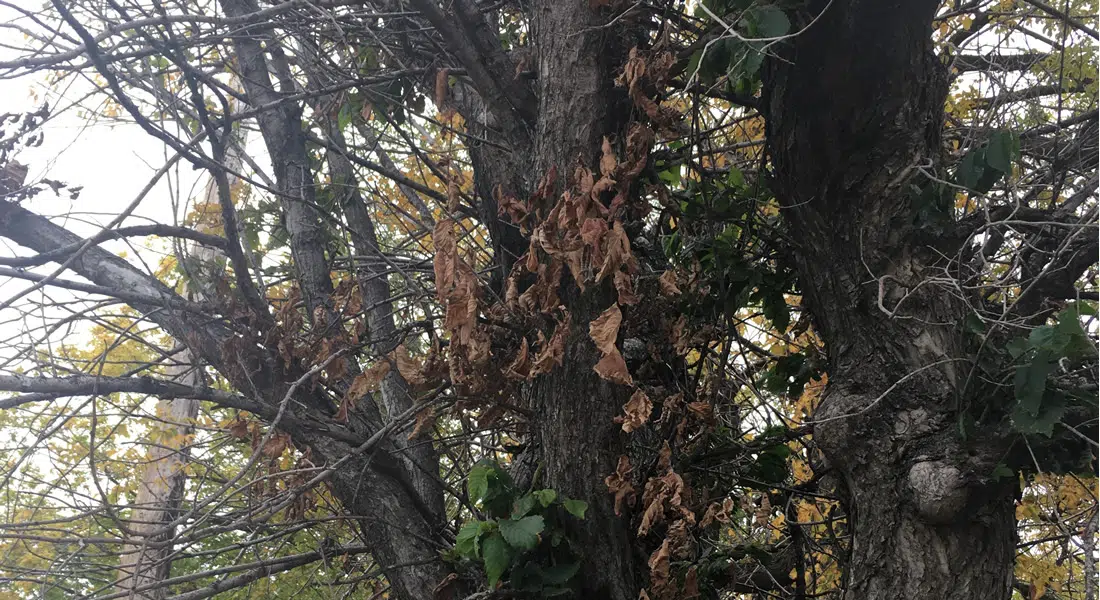
Six trees in Saskatoon have been confirmed to have Dutch elm disease. The City of Saskatoon Parks Department has confirmed the cases in three elm trees in the Varsity View neighbourhood, one in North Park and two in Westmount. Director of Parks, Thai Hoang, notes that a quarter of the city’s urban forest is elm.
He stresses that residents should not store elm wood on their property because it threatens the city’s historic tree canopy, so everyone should check their property. City staff have already seized 2,000 kilograms of elm wood in sweeps of the Varsity View neighbourhood following a previous removal of a tree with Dutch elm disease.
Click here for a representation of what Woodlawn Cemetery would look like without its elm trees.
Typically the leaves on American elm trees with DED will start to wilt and turn yellow, then curl and turn brown. He says if anyone suspects an unhealthy elm tree or are unsure of what type of firewood they have, they can take a photo and complete the online form or call Urban Forestry at 306-975-2890.
Hoang reminds residents they can help prevent Dutch elm disease by:
- Never storing elm wood or branches. Don’t buy or take elm wood from anyone and don’t burn it.
- Not pruning elms during the provincial pruning ban (April 1 to August 31).
- Disposing of elm wood at the Saskatoon Landfill.
- Do not take elm to the compost depot or put it in your green bin.
- Dispose of it immediately, disposal of residential elm wood at the Landfill is free.
The City has already initiated its DED Response Plan, which includes:
- Immediate removal of the positive tree(s) and disposal at the City landfill
- Increased surveillance of the surrounding area to search for stored elm wood
- Sampling of symptomatic trees within one kilometre of the infected tree
- Continuing regular elm surveillance and cyclical pruning of trees in parks and on boulevards
DED is a serious disease caused by a fungus that clogs the elm tree’s water and nutrient conducting system, which eventually causes the tree to die. DED was introduced in North America in the 1930s and has since wiped out millions of elms across Canada and the United States. In Saskatoon, elms make up 25% of our urban forest.