




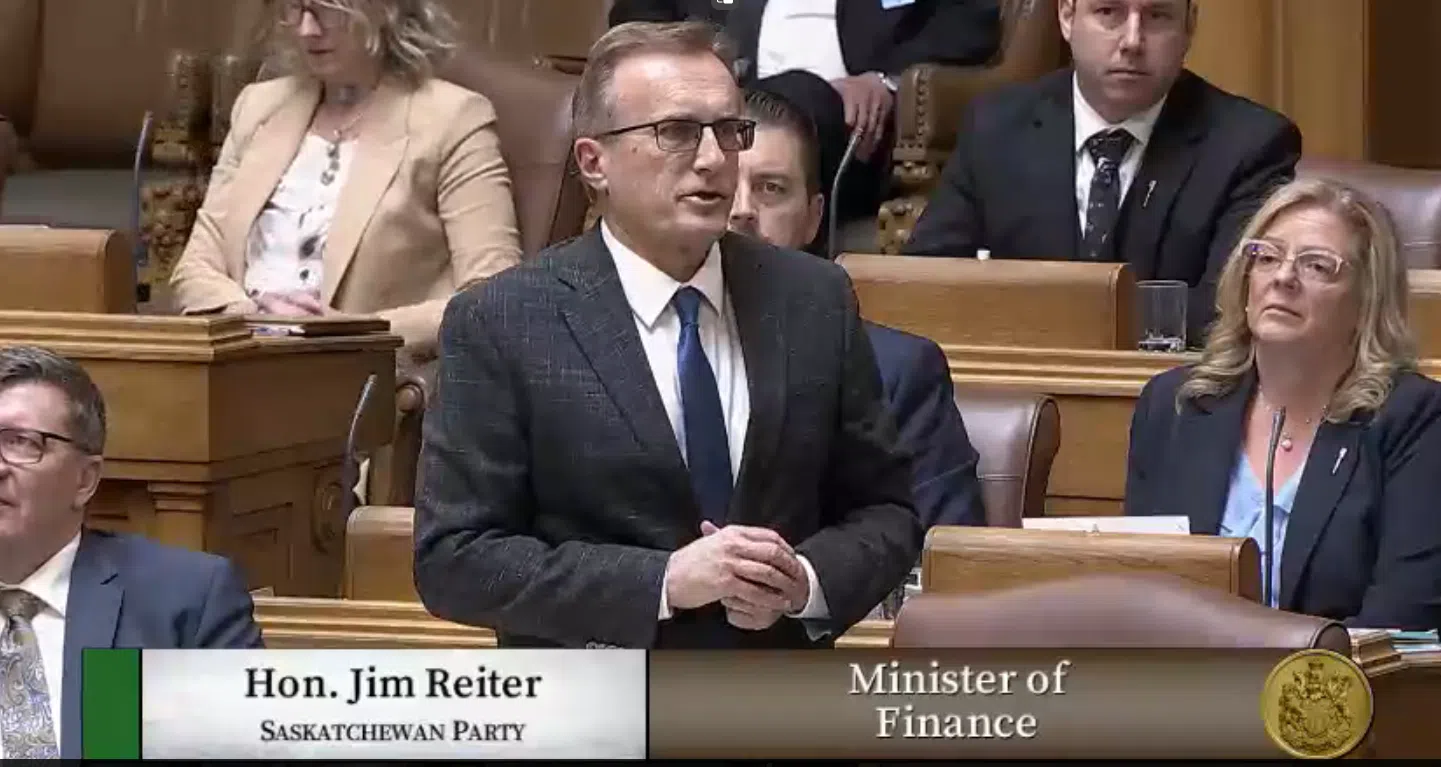
The provincial government released its 2026-27 budget on Wednesday, which includes $21.42 billion in revenue and just over $22.2 billion in expenses, resulting in deficit of $819.4 million. This year’s spending also brings Saskatchewan’s total debt up to $38.33 billion.
Finance Minister Jim Reiter says in the face of uncertainty, geopolitical turmoil, and inflationary pressures, he had to make a choice between raising taxes, cutting services, or running a deficit. Reiter says he chose to do the latter. Although taxes weren’t raised per se, several fees were introduced in recent days for those who do business with SGI, those who hunt, electric vehicle drivers, and SINP users.
He also shared that, after listening to the voices of Saskatchewan residents, it became apparent that they are looking for two specific measures in this budget: access to healthcare and affordability. He believes his finished product addresses both concerns.
In an effort to cut unnecessary spending, Reiter explains that the Province will be conducting job reviews as employees retire or leave their positions to determine whether or not they need to be replaced.
Below are the investments and initiatives included in the budget listed by ministry.
Health Care
Starting off with the sector seeing the largest provincial investment this fiscal year, health care is expected to receive a record $8.47 billion, an increase of nearly 5 per cent over last year.
Some key initiatives being targeted with this funding include access to patient care, which is being addressed through $5.15 billion being allocated to the Saskatchewan Health Authority. Nearly $12 million will be put toward Primary and Preventative Care, funding additional independent nurse practitioner contracts and working towards the province’s goal of ensuring every resident has a primary care provider by the end of 2028.
Another $98 million investment aims to push for the addition of 146 more hospital beds in Saskatoon, further invest in Emergency Medical Services, and augment critical care and other acute care supports.
The budget reads that this funding will also support the establishment of five more Urgent Care Centres in Moose Jaw, North Battleford, Prince Albert, Regina and Saskatoon. Regina will also be getting a multiple sclerosis clinic.
For seniors and those with complex needs, $9.2 million is going towards enhancing long-term care supports, including staffing for new beds in Regina and La Ronge, and enhanced inspection, oversight and quality improvement.
Mental Health and Addictions
Also in the health category, but under a separate budget line, the Ministry of Mental Health and Addictions will also receive a record investment of $673.7 million: a $49.9 million or 8.0 per cent increase from 2025-26. This budget lays out a plan to provide more than $23 million for the creation of about 200 more addictions treatment and recovery spaces and expand access to mental health and addictions supports as the rate of social disorder and mental illness continues to escalate.
Of this funding, the Province says $10.8 million will accomplish the goal of adding 500 addictions treatment spaces by March 2027, establish a six-bed secure youth detox site at the Calder Centre in Saskatoon, and expand Rapid Access Counselling services for adults.
A $9.6 million funding increase aims to support the government’s adoption of a Recovery-Oriented System of Care, and the remaining $26.5 million is earmarked for addressing the increased utilization of hospital-based services, physician visits and prescription drug costs.
Community Safety
Similarly to Mental Health and Addictions, the Ministry of Community Safety also works to address social disorder and crime, but through the use of enforcement instead. The Ministry will be getting $740 million, and the Saskatchewan Public Safety Agency another $140 million, to support safer communities across the province.
About $310 million will benefit Royal Canadian Mounted Police operations in Saskatchewan, including $26 million for First Nations policing. Another $190,000 will support the Small Town and Rural policing grant program, and nearly $6 million aims to support the Safer Communities and Neighbourhoods initiative.
The hire of 100 new municipal officers is included in the budget for another $11.9 million, and the Municipal Police Grant program will receive an increase of $583,000 to boost capacity for frontline officers responding to calls for service.
For those dealing with mental health issues or special requirements, the Province is allocating $2.7 million to establish a Complex Needs Facilities in both North Battleford and Prince Albert. Almost $2 million will establish Hospital Public Safety Teams in Regina, Saskatoon and Prince Albert, providing additional on-site security capacity in response to rising violence. The province will also see another $2 million invested in the electronic monitoring program, which closely monitors people in the community who have previously offended.
Education
Those working in or attending Prekindergarten to Grade 12 education are slate to receive $3.6 billion. Saskatchewan’s 27 school divisions will see a 2.6 per cent funding increase year over year, splitting $2.5 billion in school operating funding. The Province says this money will help establish 50 Specialized Support Classrooms, bringing the total number to 108 across all 27 school divisions.
Within the investment sits $123.8 million for school capital, which will help fund three new schools; a joint-use public and Catholic middle/high school in Martensville; Warman and a new school in Shellbrook to consolidate and replace the existing elementary and high schools; and a major renovation of Esterhazy High School.
The budget also includes $9.2 million to secure the continuation of the National School Food Program, and another $11.7 million to support the provincial public library system, something the Opposition NDP has been calling for over several months.
Post-secondary Education
Saskatchewan’s post-secondary institutions will see a 7.5 per cent funding increase this year though a $847.1 million investment.
The budget sets aside $4.1 million in new funding to add 20 physician and 26 nurse practitioner seats across the province in the 2026-27 academic year. These seats will allow for the training of more doctors and nurse practitioners.
The Province says an additional $9.9 million will finalize implementation of three new domestic health care training programs slated to start this fall: respiratory therapy, occupational therapy and speech language pathology. Last year’s physician assistant program will also be extended with an investment of $3.8 million.
Something new, a multi-year funding agreement will provide about $250 million to post-secondary institutions over the next four years. Under this agreement, post-secondary students will also notice a lower annual tuition increase limit. Institutions have committed to limit tuition increases to a range of zero to three per cent.
Social Services
The Ministry of Social Services budget will see an increase of $71.9 million this year, speaking to the state of the province’s most vulnerable population as it grows.
The Ministry will have $1.69 billion this year to deliver its highly sought after programs and services. With the investment, core income assistance benefits will be raised by two per cent beginning this May. Saskatchewan Income Support clients will receive higher monthly benefits, and monthly benefits will increase for Saskatchewan Assured Income for Disability clients, as well.
Monthly Saskatchewan Housing Benefit rates will be increased to assist those who hope to rent with affording rent and utility costs. This program will also be expanded to include over 300 new clients.
Highways
The state of Saskatchewan’s highways is being addressed via a $764 million investment. Some of the highway projects on the to-do list for the upcoming year include the twinning on Highway 2 north of Prince Albert, the completion of the twinning and corridor improvements on Highway 5 east of Saskatoon, and passing lane projects for Highway 10 between Fort Qu’Appelle and Melville, along with Highway 17 north of Lloydminster.
Thirteen bridges and culverts across the province will receive some TLC to the tune of $78 million, including the Highway 2 over Highway 1 overpass project at Moose Jaw, and the replacement of the Highway 955 bridge over Clearwater River about 60 km north of La Loche.
The Ministry’s goal to improve 10,000 kilometres of highway by 2030 will be brought into reach, as this year’s investment will bring the total to over 7,900 km after seven years.
Agriculture
The Province categorizes its investment into Saskatchewan’s farmers as a “strong commitment to agriculture”, tabling a $662.7 million investment, which is an increase of $37.4 million over 2025-26.
Agriculture Minister David Marit says this money will protect farmers faced with market volatility and weather-related challenges. For example, an $89.4 million investment through the Sustainable Canadian Agricultural Partnership aims to support programs to strengthen the agri-food sector. Another $524.3 million investment in several business risk management programs such as Crop Insurance and AgriStability, attempts to give producers reliable coverage in case of a less-than-ideal year.
Research is also an evident priority, with $37 million budgeted for the development of new technologies. The funding favours crop and livestock research facilities, research chairs to advance strategic priorities and train the next generation of producers, agronomists and scientists, and projects that demonstrate innovative technologies to producers and agronomists at the local level.
Sask Builds and Procurement
One of the most substantial investments in the budget, this years’ capital project funding sits at $4.3 billion, among the largest total capital budgets in Saskatchewan’s history.
Health sector projects will see $635.7 million of that funding, including $238.4 million for redevelopment of the Prince Albert Victoria Hospital, $100.0 million for the Regina Long Term Care specialized beds facility, and $81.8 million for other capital initiatives including funding for additional urgent care centres. Another $50.2 million will go toward several integrated and long-term care facilities in Grenfell, La Ronge, Esterhazy and the Battlefords, and $1.8 million will be use on the pre-design phase of the new Yorkton Hospital.
Other priority projects that will benefit from this money include the complex needs facilities in North Battleford and Moose Jaw, additional urgent care centres in Saskatoon, Regina, Moose Jaw, Prince Albert and North Battleford and hospital in Rosthern.
Several ongoing school capital projects in Martensville, Warman, Shellbrook, Esterhazy, Balgonie, Carlyle, Saskatoon, Regina, Prince Albert, Pinehouse and Swift Current will be bolstered with the funds, as well, and $20 million will be used to purchase relocatable classrooms.
Post-secondary schools will also reap the benefits of the investment, with $24.6 million allocated to structural maintenance and improvements at Universities, Saskatchewan Polytechnic and Regional Colleges; $10.4 million to create space for the new occupational therapy and speech language pathology programs at the University of Saskatchewan; $10 million for design and planning of Saskatchewan Polytechnic’s campus renewal project in Saskatoon; and $4.6 million to support priority health care training expansions at Saskatchewan Polytechnic campuses in Regina and Saskatoon.
Also, $102.2 million will be used to support the SPSA’s Next Generation Airtanker Fleet purchase program, and in the same vein, $2.5 million will go toward replacing infrastructure lost due to wildfires.
Unrelated, $15.5 million will be put toward the continued design and legal work for the Lake Diefenbaker Irrigation Project.
First Nations and Metis programs and Services
First Nations and Metis Services will be getting $324 million in funding, targeted at prioritizing cultural initiatives and post-secondary institutions.
For example, $24.4 million will support Teacher Education Programs, student support services and scholarships and provide additional operational funding to Indigenous institutions.
The budget also sets aside some cash, $25.6 million, for First Nations policing, including funding to expand the First Nations Community Safety Program.
The Province also anticipates a sizeable increase in gaming payments at $137.9 million this year. This is a $30.5 million increase over last year’s amounts. Gaming payments are based on casino and online gaming profits, and are often reinvested into economic, cultural, educational and social programs.
Energy and Resources
Not so many investments into resources this year, however there will be some changes.
For example, the Province says the modernization of Saskatchewan’s timber royalty system will come into effect this year. These changes aim to keep the industry competitive with other jurisdictions and support the forestry industry in meeting Saskatchewan’s Growth Plan goal to double the size of the forestry sector by 2030.
Also under the heading of energy and resources, this year’s budget includes $2.3 million for the Saskatchewan Geological Survey’s Public Geoscience Initiative, which isin its third year. The budget also provides $3.5 million for the continuation of the Targeted Mineral Exploration Incentive, a program designed to grow and diversify Saskatchewan’s mining sector and drive mineral exploration activity
Environment
The Saskatchewan Fish Hatchery will undergo the first steps of modernization with a $700,000 investment.
In addition to this project, the ministry will also begin planning a new standalone walleye intensive rearing facility. “Advancing the modernization and rearing facility at the same time will allow the ministry to find efficiencies and achieve economies of scale.”
Career Training
A lack of local skilled labour has prompted a $125 million investment into the Ministry of Immigration and Career Training.
Over $21 million will support adult essential skills training such as literacy and job interviewing skills. Another $22.2 million is being allocated to training programs delivered through post-secondary institutions, and $25.9 million for similar pre-employment programs and services will boost work placement opportunities and career counselling.
Those with disabilities will benefit from $10.4 million in preparation for the transition into the workforce. An additional $2 million will add 300 apprenticeship training seats for skilled trades people, bringing the total to 5,300.
Parks, Culture, and Sport
As part of the Parks, Culture, and Recreation budget, the Province is doubling the Active Families Benefit with $4 million in new funding. An identical funding increase will support doubling the income threshold from $60,000 to $120,000 per year and doubling the benefit amount from $150 to $300 per child or $200 to $400 for children with disabilities.
Switching from sport to arts and culture, continued funding of $10 million will boost the Feature Film & Television Production Grant, and a $16.5 million capital investment aims to modernize the Royal Saskatchewan Museum’s Research, Exhibits, and Collections Centre in Regina.
Justice
The province hopes to increase capacity within the Ministry of Justice and Attorney General through investing nearly $269 million.
Initiatives undertaken with this funding include the appointment of four new Court of King’s Bench associate judges, three new Provincial Court judges, six new justices of the peace, and two new Crown prosecutors specializing in provincial immigration and taxation offences.
Another $3 million portion of the funding will be earmarked for the Court Modernization Project, which plans to modernize courtroom technology and infrastructure, enhance safety and security, and continue implementation of the Judicial Scheduling, Tracking and Amalgamated Reporting system.