




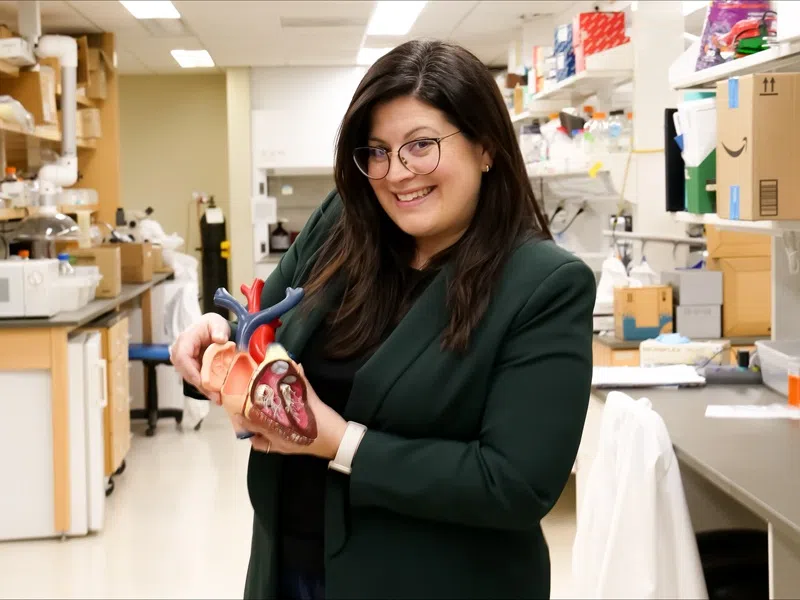
A professor at the University of Saskatchewan (USask) is doing research on the development of atrial fibrillation, a condition that causes irregular heartbeats.
Dr. Michelle Collins says that while aging and obesity can play a role in developing atrial fibrillation, her research is focused on the genetic factors behind the disease.
“Genetics has a strong component in developing AF (atrial fibrillation). And so my lab’s been studying one of these genetic factors that is linked to atrial fibrillation called PITX2. This is a special gene, it does a lot of stuff during early heart development, and we think it plays a critical role in protecting the heart as it ages.”
Dr. Collins is conducting much of the research by studying zebrafish that lack the PITX2 gene. She says these fish develop conditions that resemble atrial fibrillation as they reach adulthood.
“The zebrafish is a really cool model to study the heart. We do a lot of our work in early stages where we can visualize the heart really easily like using a microscope, because the fish are transparent. All of the same genetic building blocks that build a human heart are at play in making a zebrafish heart, so we think we can extend a lot of our findings from this type of a model to understand what’s going on in a human.”
She says the findings will be used to improve heart health care for atrial fibrillation.
“By taking apart the biology and the cellular changes that are happening in the heart in our zebrafish model of PITX2, we start to understand how we can therapeutically target it and develop more effective treatments to protect the heart.”
Dr. Collins said that her research is made possible through a recent grant of over $900,000 from the Canadian Institutes of Health Research.