



Saskatoon residents can expect some pretty significant structural changes to First Avenue as part of the rollout of the Link Bus Rapid Transit System.
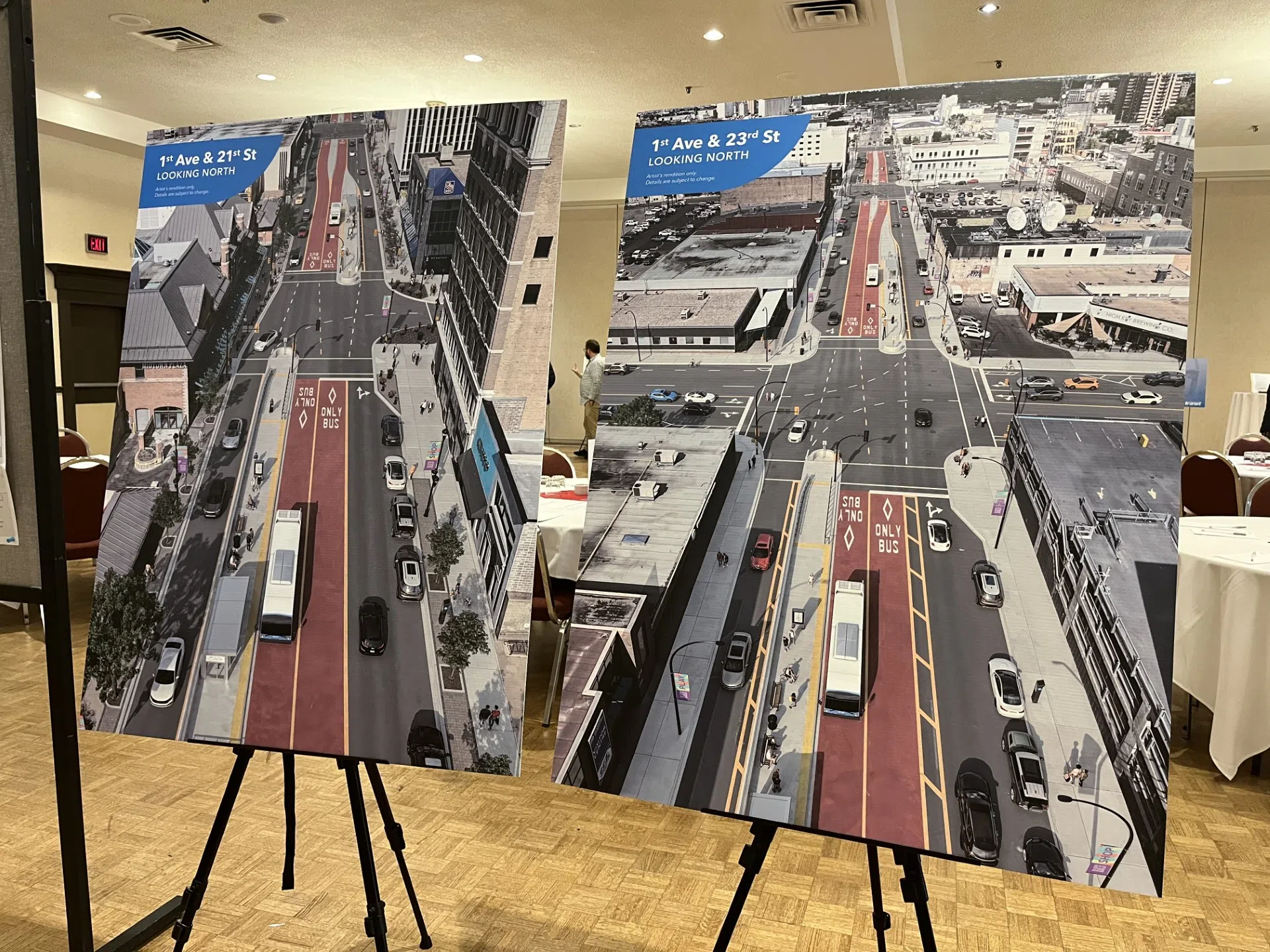
Those curious about what they should expect gathered at a City information session Thursday afternoon at the Hilton Garden Inn. The session focused on the design of the transit-only lanes on First Avenue, where all three BRT lines will converge, making for quite the busy corridor. Special Projects Manager Rob Dudiak says residents have provided mixed feedback, with the main concerns revolving around parking implications and navigation while driving amid the transit-only lanes.
“The lanes themselves will actually be coloured red,” he explains. “There will be signage. There’s different signals that get installed as well, transit specific signal infrastructure.”
He adds that if everyone who drives the corridor today continues to drive it after the changes are made, they should expect to spend an extra two minutes on their drive between 25th and 19th Street according to the City’s traffic modeling studies.
The City is also proposing the removal of 61 parking stalls along First Avenue, reducing the number of on-street spaces from 308 to 247.
Saskatoon resident and architectural technologist Cary Tarasoff was at the information session, as well. He finds issue with the majority of the BRT design and says trolley buses would be more efficient, affordable, and environmentally friendly. He adds that the current plan was rushed, pointing out several of what he calls flaws in the City’s blueprint. These included a lack of space for snow storage and the removal of several left turns coming on and off of First Avenue. Dudiak confirmed the lefthand turn from 25th Street westbound onto First Avenue southbound will be removed. Drivers won’t be able to turn off of First Avenue onto 23rd to go west or east, and motorists won’t be able to make the southbound left onto 21st street eastbound from First Avenue.
Tarasoff says he doesn’t see a need for the construction of the concrete bus pads that you may have seen pop up around the city over the summer, as he says they were intended to mitigate the weight of electric buses, which the city is no longer trying to implement.
“We’re putting all of these concrete pads in the streets that you notice around the city because of heavy (electric) battery buses. They’re so heavy, but we’re not buying those (buses anymore) because they failed, so we’re buying diesel buses again.”
He’s referring to a recent report from the Canadian Urban Transit Research and Innovation Consortium or CUTRIC, which directed the City to move towards establishing a diesel bus fleet following a feasibility study of electric buses.
“We’ve sunk everything into this in a big hurry to do it, and we’re going to damage the downtown forever with these stupid ideas.”
City crews spent the summer completing 41 concrete bus pads and platforms. Next steps include starting work on College Drive in 2026, the construction of bus shelters next summer, and a proposed service launch by 2028. There is a second info session taking place on Monday between 4:00 and 7:00 pm at the Hilton Garden Inn.