




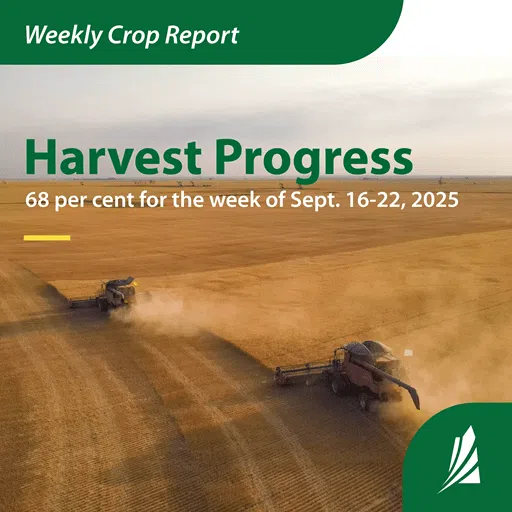
Combining remains behind the five-year (83 per cent) and ten-year (72 per cent) averages, but made decent progress last week in spite of some late combine starts.
Fog and higher humidity meant farmers could not get on the field as soon as they wanted, according to Tyce Masich, an extension specialist with the Saskatchewan Ministry of Agriculture extension specialist.
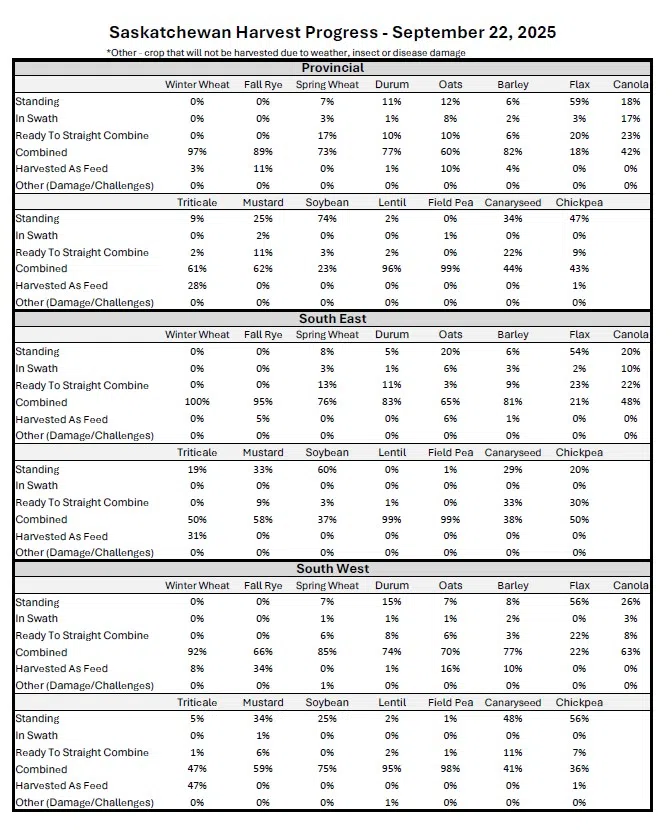
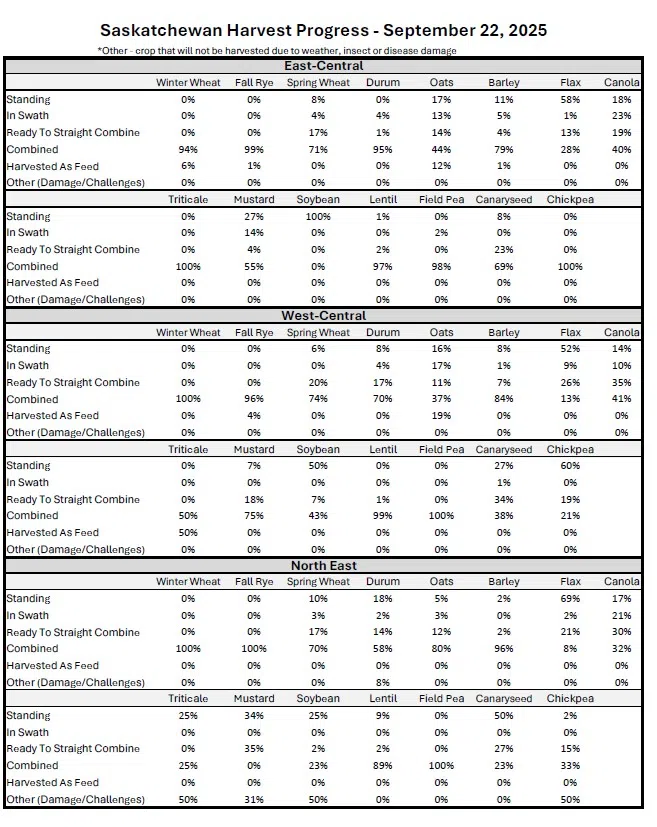
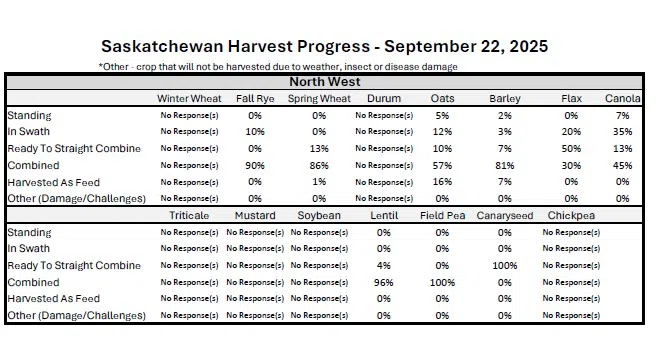
Breaking down harvest progress by region, the southwest is 80 per cent combined, southeast (70 per cent), northwest (69 per cent) west-central (65 per cent), northeast (61 per cent) and east-central (59 per cent).
Harvest progress by crop has peas at 99 per cent combined, lentils (96 per cent), barley (86 per cent), durum (78 per cent), spring wheat (73 per cent), oats (70 per cent), canola (42 per cent), soybean (23 per cent) and flax (18 per cent).
The largest amount of rain last week was recorded at Rhein—east of Yorkton—at 44 millimetres. Carnduff and Blaine Lake each had 20 millimetres.
Provincial cropland topsoil moisture is rated at two per cent surplus, 59 per cent adequate, 32 per cent short and seven per cent very short. Masich says farmers are prepared for potential fire under the dry conditions.
Waterfowl damage was more present this week as geese, cranes and other waterfowl continue their journey south.
Check out the charts below as well as the full region-by-region crop report.
Census Division 1 – Carnduff, Estevan, Lampman, Redvers and Stoughton areas
Census Division 2 – Avonlea, Fillmore, Minton, Radville and Weyburn areas
Census Division 5 – Broadview, Esterhazy, Melville and Moosomin areas
Census Division 6 – Belle Plaine, Cupar, Lumsden, Indian Head, Regina and Rouleau areas
The rain and humidity over the week caused most producers to pause harvest until the weekend. Cereals remaining in the field are reported to have sprouting and poor quality. There have also been some reports of sprouting in canola. With the warm weather over the weekend and forecasted for the upcoming week, farmers are looking forward to long days of harvesting.
Despite moisture delays, harvest progressed to 70 per cent complete. Harvest of winter wheat and fall rye is complete. Lentils and field peas are sitting at 99 per cent complete. For cereals, spring wheat is at 76 per cent combined, durum is at 83 per cent, oats are at 71 per cent and barley is at 82 per cent combined. For oilseeds, canola is 48 per cent combined, flax is at 21 per cent, mustard at 58 per cent and soybeans at 37 per cent. Other crops being harvested are triticale at 81 per cent combined, canaryseed at 38 per cent and chickpeas at 50 per cent combined.
Many areas in this region did not receive rainfall this week. The most rain was recorded in the Carnduff area with 20 millimetres (mm). Other higher amounts of rain were 10 mm in the Wolseley area and 8 mm in both the Indian Head and Kipling area. There was up to four mm recorded in all other areas. Topsoil moisture conditions are only slightly decreasing in the area with cropland having two per cent surplus, 81 per cent adequate, 14 per cent short and three per cent very short. Hayland topsoil moisture is two per cent surplus, 81 per cent adequate, 12 per cent short and five per cent very short. Pasture topsoil conditions are two per cent surplus, 77 per cent adequate, 16 per cent short and five per cent very short.
Pasture conditions have decreased slightly in the southeast. Conditions are two per cent excellent, 50 per cent good, 32 per cent fair, 13 per cent poor and three per cent very poor.
The majority of crop damage this past week was due to winds and water accumulation in low spots. There were also reports of damage caused by wildlife that have trampled and/or eaten crops still in the field. Some producers are noticing diseases in canola crops such as Alternaria black spot and verticillium strip, but reports are minor and not widespread.
Census Division 3 – Assiniboia, Gravelbourg, Mankota, Ponteix and Rockglen areas
Census Division 4 – Cadillac, Consul, Eastend, Maple Creek and Val Marie areas
Census Division 7 – Beechy, Central Butte, Craik, Herbert, Hodgeville and Moose Jaw areas
Census Division 8 – Cabri, Elrose, Fox Valley, Leader, Swift Current and Tompkins areas
Heavy fog caused a slow starts this week but harvest still progressed and is now sitting at 80 per cent complete in the region. The main challenge in the area is second growth of crops and weeds causing slow dry down and curing. The area is dry and farmers and ranchers are hoping for rain soon. Some reports of poor water quality in dugouts are starting to come in.
Winter wheat and fall rye harvest are complete in this region. Following close behind is the pulses with 96 per cent of the lentils combined and 98 per cent of the field peas. Cereal harvest is also nearing completion with spring wheat 86 per cent combined, durum 75 per cent, oats 85 per cent and barley 87 per cent. Canola harvest ramped up this week with 63 per cent combined. For other oilseeds, flax is 22 per cent combined, mustard 59 per cent and soybeans 75 per cent. Other crops being harvested are triticale at 94 per cent combined, canaryseed at 41 per cent combined and chickpea at 37 per cent combined.
Dry conditions continued in the southwest this week with the most rain recorded being 3 millimetres (mm) north of Mossbank. Topsoil moisture is becoming limited in the area with the dry conditions. Cropland topsoil moisture is sitting at 40 per cent adequate, 55 per cent short and five per cent very short. Hayland topsoil moisture conditions are at 37 per cent adequate, 38 per cent short and 25 per cent very short. Pasture topsoil moisture conditions are 35 per cent adequate, 43 per cent short and 22 per cent very short.
Pasture conditions have declined in the southwest with the dry conditions. Currently they are reported at 34 per cent good, 44 per cent fair, 16 per cent poor and six per cent very poor.
Crop damage in this area is mainly caused by wind, heat and dry conditions. Grasshoppers are also being reported as mild-moderate in the region. Diseases of prevalence being reported are anthracnose in lentils and Alternaria blackspot in canola.
Census Division 12 Biggar, Delisle, Rosetown and Sonningdale areas
Census Division 13 Cut Knife, Kerrobert, Kindersley, Macklin, Plenty and Wilkie areas
Harvest in the west-central area is progressing well, only being slowed down by some humid mornings causing slow starts. Farmers are looking forward to another good week of weather to finish up harvest
Harvest in west-central is 65 per cent complete. Many farmers are now moving onto canola which is one of the final crops to combine. Harvest is complete in this region for winter wheat, fall rye, triticale and field peas. Lentils are close behind at 99 per cent complete. Cereal crops follow with spring wheat at 74 per cent combined, durum at 70 per cent, oats at 56 per cent and barley at 84 per cent. Oilseed harvest is progressing with canola at 41 per cent combined, flax at 13 per cent, mustard at 75 per cent and soybeans at 43 per cent. Other crops being harvested in the area are canaryseed at 38 per cent combined and chickpea at 21 per cent.
No rainfall was reported in this region except for the Harris area receiving 12 millimetres (mm). A few weeks without rain has caused topsoil moisture conditions to drop significantly in this region. Currently cropland topsoil moisture is reported at 28 per cent adequate, 55 per cent short and 17 per cent very short. Hayland topsoil moisture is 28 per cent adequate, 56 per cent short and 16 per cent very short. Pasture topsoil moisture sits at five per cent surplus, 20 per cent adequate, 58 per cent short and 17 per cent very short.
Pasture conditions have decreased in this region due to very low rainfall the past few weeks. Conditions are now sitting at 19 per cent good, 56 per cent fair, 20 per cent poor and five per cent very poor.
The only crop damage reported for this region was minor damage from dry conditions and wind, wildlife and waterfowl. Harvest still underway but producers are hopeful for substantial post-harvest rainfall to replenish soil moisture and mitigate some of the negative effects of the dry conditions.
Census Division 9 – Calder, Canora, Pelly, Preeceville, Sheho and Yorkton areas
Census Division 10 – Foam Lake, Kelliher, Leroy, Raymore and Wadena areas
Census Division 11 – Davidson, Colonsay, Langham, Lanigan, Nokomis, Outlook and Saskatoon areas
Harvest was slow this week due to damp conditions in the fields. Harvest has now resumed at a steady pace. Producers are reporting bleached kernals and poor cereal quality as a result of the recent rains. Yields are being reported as better than expected considering the spotty rains in the area this season.
Harvest is sitting at 59 per cent complete in this area. With warm, dry weather this coming week, harvest progress is expected to increase significantly. Winter wheat, triticale, chickpea and fall rye harvest is complete in this region. Crops that are nearly complete are lentils at 97 per cent combined and field peas at 98 per cent. Cereals are nearing completion with spring wheat 71 per cent combined, durum 95 per cent, oats 56 per cent and barley 80 per cent. Oilseed harvest is also progressing; canola is 40 per cent combined, mustard 55 per cent and flax 28 per cent. Canaryseed is 69 per cent combined in the region.
Most producers in this region did not receive rain this week. There were some isolated showers east of Yorkton that accumulated 18 millimetres (mm) in the Calder area and 44 mm in the Rhein area. Due to the limited rainfall in most areas, topsoil moisture conditions are starting to drop in this region. Cropland topsoil moisture sits at seven per cent surplus, 66 per cent adequate and 27 per cent short. Hayland topsoil moisture conditions sit at 10 per cent surplus, 60 per cent adequate and 30 per cent short. Pasture topsoil moisture conditions sit at nine per cent surplus, 45 per cent adequate, 34 per cent short and 12 per cent very short.
Pasture conditions in the east-central have decreased slightly in the past month. Conditions are now sitting at two per cent excellent, 29 per cent good, 47 per cent fair, 11 per cent poor and 11 per cent very poor.
Crop damage in this area is mainly environmental. High winds have caused some crop damage as well as flooding of low-lying areas. Previous hail damage is being seen in crops resulting in yield loss during harvest. Grasshoppers are reported as minor in this region. There are a few reports of damage from diseases such as fusarium head blight and rust in the cereal crops in this region.
Census Division 14 – Choiceland, Hudson Bay, Kelvington, Melfort, and Nipawin areas
Census Division 15 – Cudworth, Humboldt, Kinistino, Prince Albert, Rosthern and St. Brieux areas
Foggy and dewy mornings made for slow harvest progress in this region. The warmer weather has farmers back in the fields combining. Most farmers are moving onto canola in this region having their other crops in the bin.
Despite the slow harvest progress due to humid conditions, harvest progress is still sitting at 61 per cent complete for this region. Harvest is complete in this region for winter wheat, fall rye and field peas. Lentils are close behind at 89 per cent complete. Cereals are still being combined with spring wheat at 70 per cent combined, durum at 66 per cent, oats at 80 per cent and barley at 96 per cent. Oilseeds are starting to come off. Canola is at 32 per cent combined and flax is at eight per cent.
The most rain that fell in this area was reported in the Arborfield and Wakaw regions with two millimetres (mm), respectively. Dry conditions and humidity were very prevalent this week. Topsoil moisture conditions are dropping slowly in this area with the low rainfall. Currently cropland topsoil moisture is being reported at one per cent surplus, 88 per cent adequate, eight per cent short and three per cent very short. Hayland topsoil moisture is at one per cent surplus, 74 per cent adequate, 22 per cent short and three per cent very short. Pasture topsoil moisture is at one per cent surplus, 70 per cent adequate, 25 per cent short and four per cent very short.
Pasture conditions have decreased slightly in the region due to low amounts of rainfall. Conditions are now sitting at two per cent excellent, 44 per cent good, 37 per cent fair, 17 per cent poor.
Crop damage in this area was mainly reported as insect damage. Damage from bertha armyworms and grasshoppers is being seen. Other crop damage reported was mild frost damage, waterfowl damage and minor damage from dry conditions.
Census Division 16 – Blaine Lake, Canwood, North Battleford, Radisson and Spiritwood areas
Census Division 17 – Glaslyn, Maidstone, Meadow Lake, Pierceland and St. Walburg areas
Humid mornings and some rain caused slow progress in this region. Farmers are struggling with second growth due to late rain; this is causing poor dry down conditions. There are many reports of livestock producers having to haul water in this region.
With the dry conditions and poor crop growth, harvest is further along in this region and is now 69 per cent complete. Harvest is complete in this region for field peas and canaryseed. Lentils are close at 96 per cent complete. Cereals are currently being harvested, with fall rye at 90 per cent combined, spring wheat at 87 per cent, oats at 73 per cent and barley at 88 per cent. Canola harvest is 45 per cent complete and flax is 30 per cent complete.
Rain fell in the Blaine Lake area this week totaling 20 millimetres (mm). Every other area reported up to 1 mm of rain for the week. Topsoil moisture conditions continue to be low in this area and have dropped. Currently, topsoil moisture is 34 per cent adequate, 43 per cent short and 23 per cent very short. Hayland topsoil moisture is 17 per cent adequate, 38 per cent short and 45 per cent very short. Pasture topsoil moisture is 17 per cent adequate, 39 per cent short and 44 per cent very short.
Pasture conditions have experienced a significant decline in this region due to low rainfall all year. Conditions are now sitting at 12 per cent good, 29 per cent fair, 31 per cent poor and 28 per cent very poor.
Crop damage this past week is mainly due to light frost, dry conditions and heat. There is also a slight increase in waterfowl and wildlife damage in the region.