




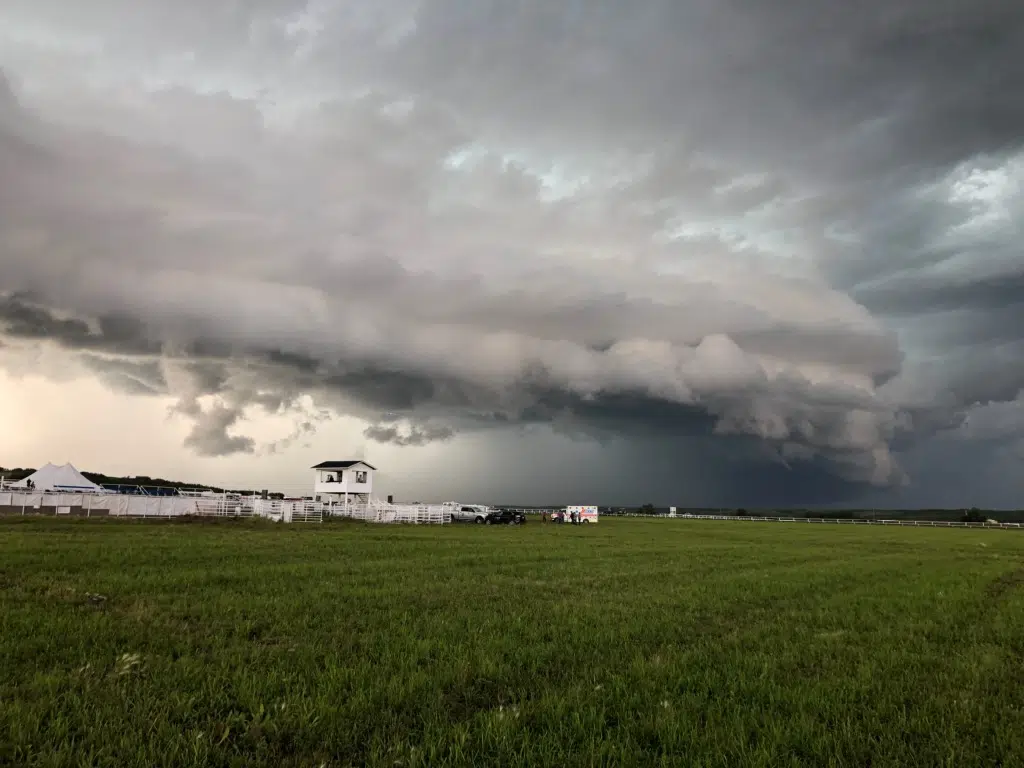
A lot of different cities and towns across the Canadian prairies experienced storm activity Wednesday night.
Environment Canada meteorologist Crawford Luke explains how it all came about, “We had this low-pressure system in Northern Saskatchewan. We also had this other low-pressure system coming up from Montana/North Dakota so the two of them really just kind of set the stage for these thunderstorms across the prairies. We’re looking at storms in southern Alberta moving into southern Saskatchewan last night. And we had these storms that moved kinda just north of Saskatoon basically right along the Yellowhead over to Humboldt.”
And he says another area of storms then hit southern Manitoba. A tornado warning was issued for several different communities in Saskatchewan and Crawford Luke says the storm that spawned a tornado warning for Saskatoon actually was the same storm that generated a tornado warning in North Battleford.
“North Battleford specifically we had a wind gust recorded there of 129 kilometres an hour which is very, very impressive.”
As the storm moved east it generated tennis ball sized hail at Radisson as well as tennis ball and baseball sized hail in Langham where residents in both communities are reporting cracked windshields.
A team from Northern Tornado Project is heading to the Cudworth and Middle Lake area to investigate a possible tornado. Another team from NTP is going to Brooks, Alberta where part of the TransCanada was shut down from damage caused by what they suspect it was a plow wind and led to so many accidents the highway became impassable. That same storm at Brooks moved east into Saskatchewan and the Kindersley area recorded a wind gust of 116 km/h.
Crawford Luke says their preliminary information indicates there were approximately 14,000 lightning strikes over the two hours that the storm was passing north of Saskatoon.
In July 2024 there was an early morning storm that generated over 7,000 lightning strikes which was considered extreme and caused by an amped number of cloud-to-cloud lightning strikes as opposed to cloud-to-ground lightning strikes.