




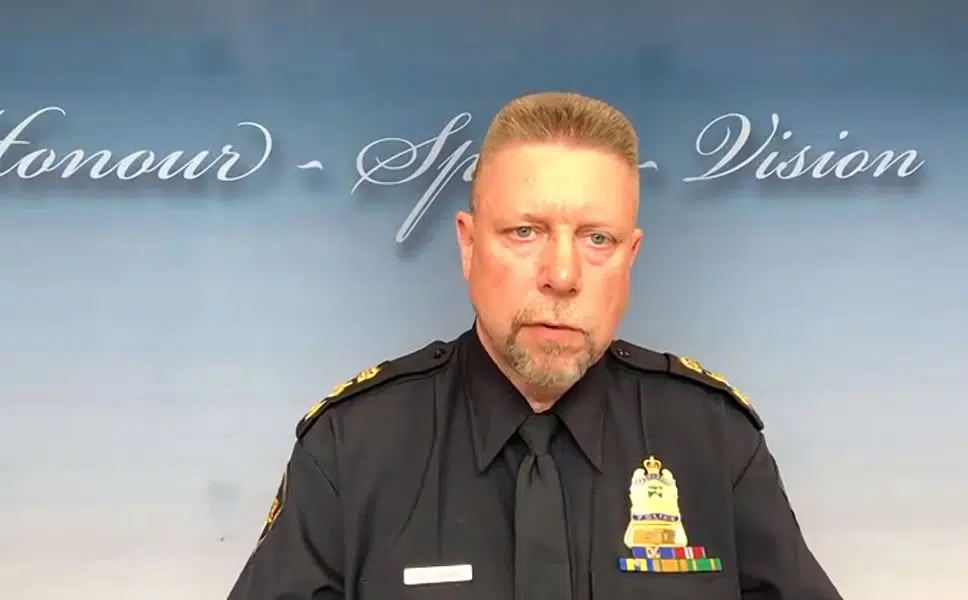
Looking back on 2020 Police Chief Troy Cooper says it is easy to look for the negative, but he believes that people in Saskatoon are generally good.
Cooper points to not only some of the things that local heroes have done during the COVID-19 pandemic, but even during the once in a decade snowstorm when people were worried about getting to work and back home. Cooper says there were 16 volunteers from Saskatoon search and rescue down at their office that day, volunteers that were going out in the community to help people that were stranded.
Cooper says 2020 was proof that public safety requires partnerships and in the last year police have relied heavily on organizations in heath in relation to COVID-19, the Saskatoon Tribal Council for help with the city’s vulnerable , the media for the city’s first ever amber alert, and schools for the city’s youth. Cooper says it’s a necessity for police services to be as focused on community relationships as they are on crime. This year Cooper explains police had to work hard to strengthen or rebuild trust with the ethno-cultural, Indigenous and LGBTQ communities. He says what they took away from 2020 was regardless of which community people identify with, what they would really like to know is that they matter, they’re important to police and considered apart of what he calls, the circle of care.
Cooper says he looks forward to stability, adding the organization is used to working in emergencies and uncertainty but even for them it’s been a challenge. He points to the police college that had to shut down, but they were able to adjust and adapt to overcome and create a new version of the college and training for staff.
Police Stats in 2020
Calls for service from the Saskatoon Police were up 1.4% in 2020. Cooper says during the pandemic safety measures required more time to maintain the level of service needed, which included a change in policies and service delivery methods. Some of the lower level calls he says we able to be adjusted to an online reporting mechanism or a call back unit. For offenses that maybe didn’t need an officer in person, the call back system was used for police to connect and take some pressure off of front line officers. Cooper says although they had more calls, they dispatched 8.5% less officers to scenes. Which he adds was significant due to the workload increase and the screening measures that were put in place for calls during the pandemic.
Year to date, Cooper states Saskatoon Police received 1200 dispatched calls to investigate either a breach of the public health order, or to confirm that someone who was required to quarantine, due to travel, was actually doing so. Three COVID-19 related fines were issued by Saskatoon Police Officers from March to December.
In 2020 Saskatoon saw a reduction in property crime but an increase in arson.
Chief Cooper states that property crime was down 17% year to date, straight across the board for crimes like theft, break and enters and robberies were down significantly. However, Cooper says that arsons were up from 65 in 2019 to 125 this year. He explains that generally arson cases spike in the summer and that happened this year too, but it started early in 2020. Cooper says the increase was maybe reflected in the reduced structure of the community, during the pandemic, and while it doesn’t appear to be a trend in the province, globally there has been some discussion that an increase in arson is linked to COVID-19.
Violent Crimes
Violent crimes in Saskatoon increased by just over 1.5% in 2020, compared to 2019.
Cooper says this is the 3rd year in a row where police have seen higher level, violent offences, increasing. This includes aggravated assaults, assaults on police officers and homicides. Domestic violence calls for service jumped up 16% and Cooper says that spike happened primarily while people were restricted to their houses during the pandemic.
Cooper explains that while homicide numbers were lower this year than in 2019, the numbers were still significant and police noticed trends in 2020. A 14% increase in firearm seizures or firearm related calls were found, and three-quarters of homicides attended had some sort of street gang affiliation to either the victim or the suspect. Cooper explains they have taken efforts into contributing to the provincial gang violence reduction strategy and it’s something they are monitoring and doing their best to resource appropriately.